Guaranteed to Succeed — How the Perceptron Promises to Find the Answer
Machine-Learning tutorial · PySpark.in
1. Introduction: A Doctor's Dilemma
Imagine a new pandemic has started. Hospitals around the world are filling up with patients. Some patients get better after a few days and go home. Others get worse and need a ventilator machine to help them breathe.
Doctors are overwhelmed. They need to decide quickly: Which patients will need a ventilator in three days?
They collect information about each patient:
- Age (how old are they?)
- BMI (are they overweight?)
- Difficulty breathing (yes = 1, no = 0)
- Fever (yes = 1, no = 0)
- Diabetes (yes = 1, no = 0)
- Chest CT scan (0 = clear, 1 = mild infection, 2 = severe infection)
Each patient becomes a list of six numbers. For example:
Patient A: [45 years, BMI 28, no breathing difficulty, no fever, no diabetes, clear CT]
The doctors label each patient after three days:
- y = -1 if the patient did NOT need a ventilator
- y = +1 if the patient DID need a ventilator
Now the big question: Can we build a machine that looks at these six numbers and predicts the correct label?
This is exactly the problem that Frank Rosenblatt's Perceptron was designed to solve. And the most amazing thing? The Perceptron comes with a guarantee. If the patients CAN be separated into two groups by a straight line (or in this case, a "hyperplane" in 6-dimensional space), the Perceptron is guaranteed to find that separator in a finite number of steps.
Let us understand how.
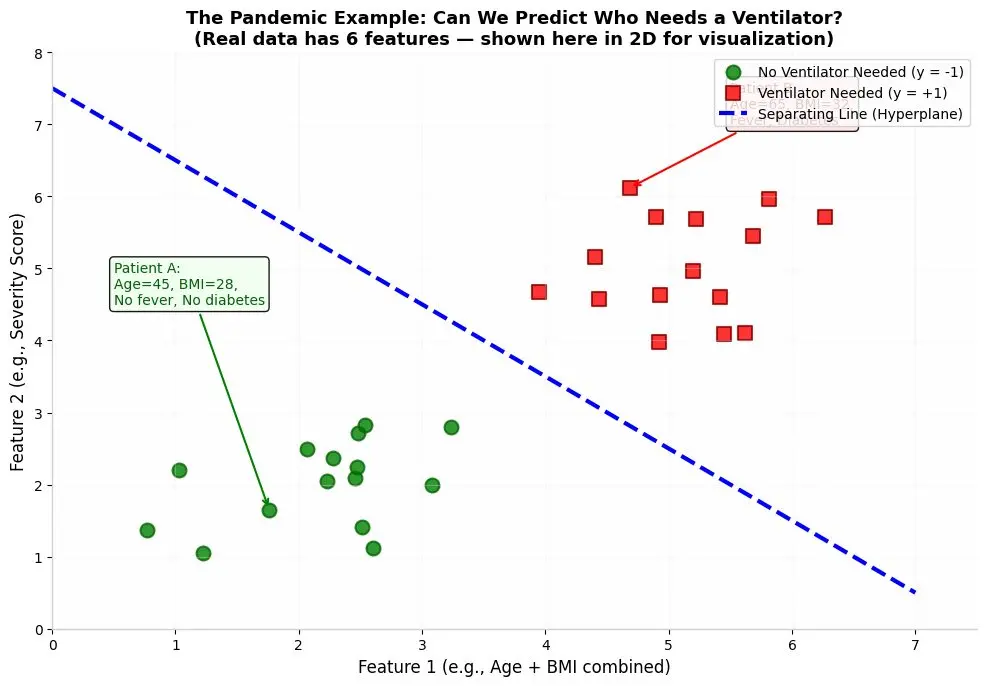
The picture above shows patients in a simplified 2D view. Green circles are patients who did not need ventilators. Red squares are patients who did. The blue dashed line is the separating boundary — the "decision line" that the Perceptron tries to find.
2. The Three-Step Recipe (The Algorithm)
The Perceptron algorithm is shockingly simple. The book describes it in three steps on page 51. Let us see it in plain English.
Step 1: Start Blind
Set the weight vector w = 0. This means the machine starts with no knowledge at all. It has not yet formed any opinion about which features matter.
Step 2: Check Every Patient
Go through every patient in your training data. For each patient x, calculate the score:
score = y (wᵀx)
Here is what this means in simple words:
- y is the true answer: +1 (needs ventilator) or -1 (does not need ventilator)
- wᵀx is the machine's guess. If it is positive, the machine thinks "needs ventilator." If negative, it thinks "does not need ventilator."
Now multiply them together:
- If y (wᵀx) > 0: The true answer and the machine's guess have the same sign. This means the machine is CORRECT. Do nothing.
- If y (wᵀx) ≤ 0: The true answer and the machine's guess have different signs (or the machine guessed zero). This means the machine made a MISTAKE. Update the weights:

This update rule is the heart of learning. When the machine is wrong, it "nudges" its weight vector in the direction of the correct answer.
Step 3: Are We Done?
If the machine went through ALL patients and made ZERO mistakes, stop! The weights are perfect.
If there was even ONE mistake, go back to Step 2 and check all patients again.
That is the entire algorithm. No calculus. No probability. Just: look, check, fix, repeat.
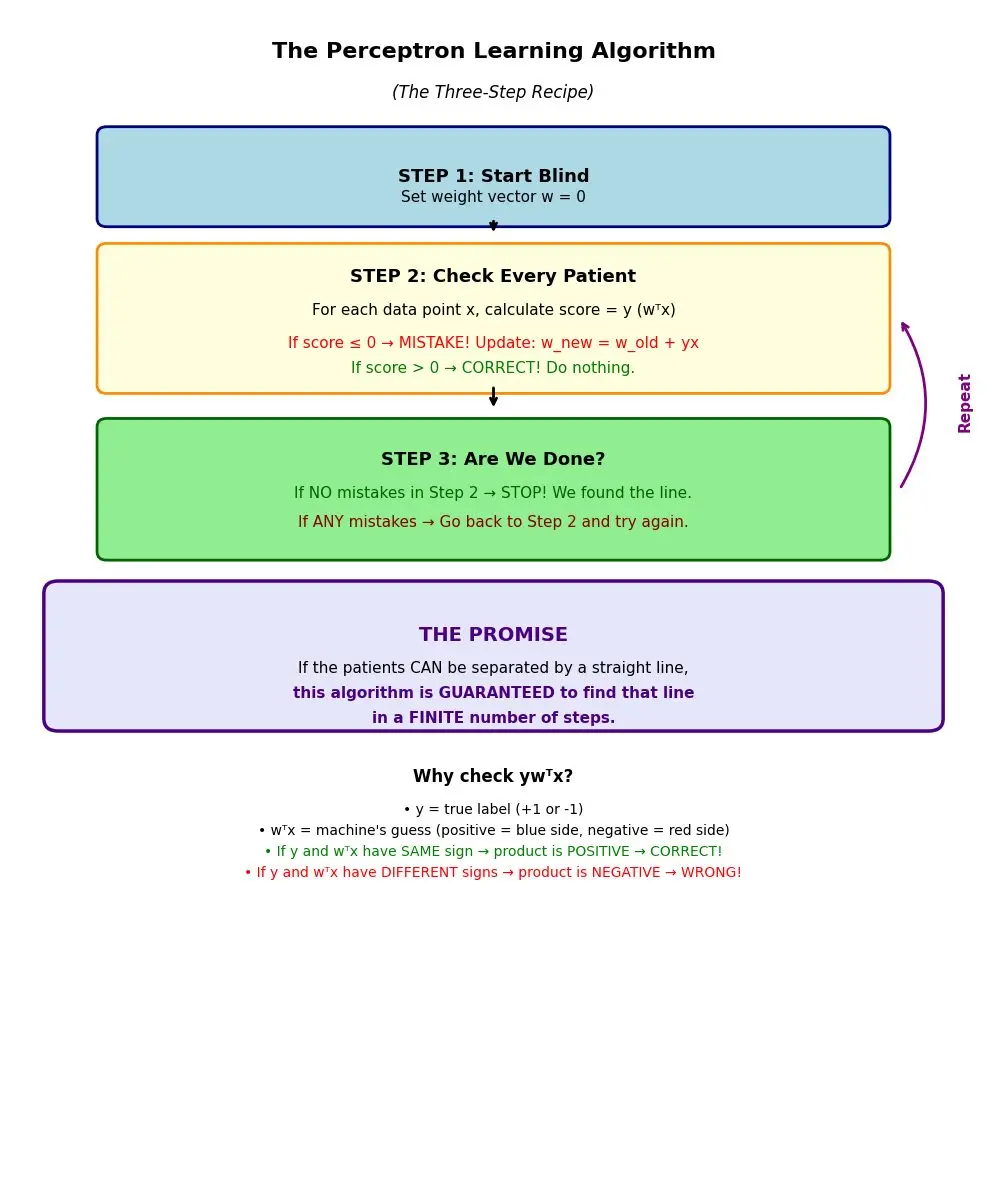
The flowchart above shows the three-step recipe. The machine starts blind, checks every patient, fixes mistakes by updating w, and repeats until perfect. The purple arrow shows the "learning loop" — the machine keeps trying until it succeeds.
3. Why Does the Update Rule Work?
Let us understand the update rule intuitively. When the machine makes a mistake on a patient x with true label y, it does:

Think of yx as a "nudge vector." It tells the machine: "Push your line in this direction so that this patient is classified correctly next time."
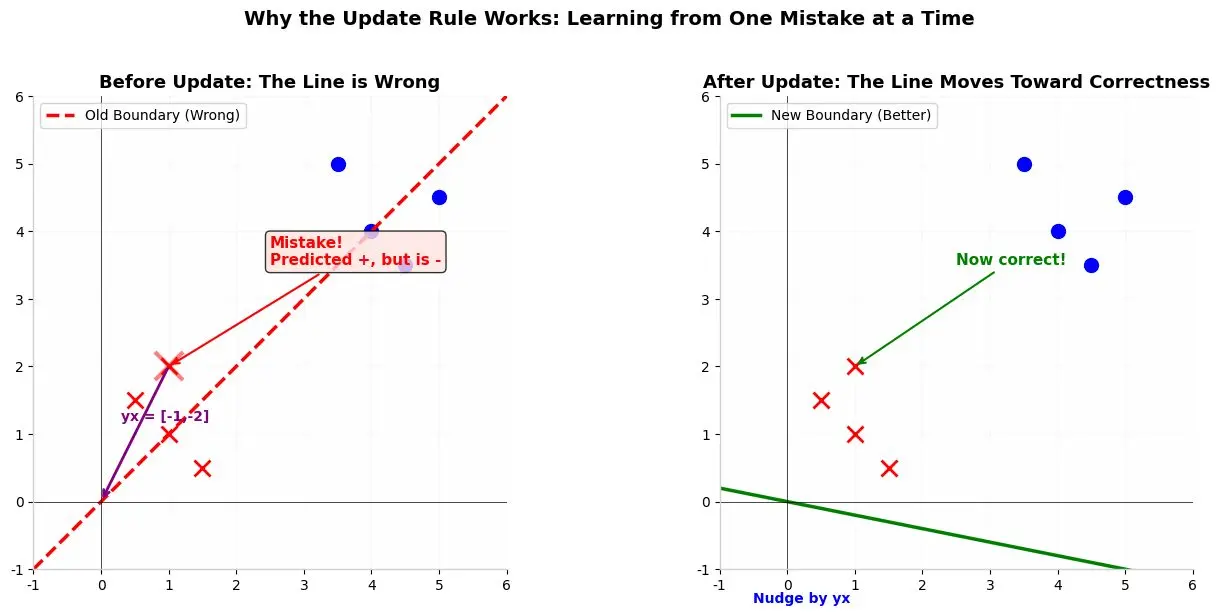
On the left, the red dashed line is wrong — a negative patient (red cross) is on the wrong side. The purple arrow shows the update vector yx. On the right, after adding this nudge, the green solid line moves to correct the mistake. The patient is now on the correct side!
But here is the deeper question: How do we know this nudge actually helps? Maybe we fix one patient but break another. Could the machine keep making mistakes forever, running in circles?
This is where the convergence proof comes in.
4. The Promise: Why the Algorithm Always Stops
The book asks the question on page 52: "How can we be sure that it will terminate? Why won't it keep going indefinitely, by always getting at least one data point wrong?"
The answer is the convergence proof. The book describes it beautifully on pages 53 and 57–63. Here is the intuition in the simplest possible words.
Imagine Two Forces
Force 1: Alignment with the Perfect Line (wᵀw*)
There exists a perfect weight vector w* that separates all patients perfectly. Every time the machine makes a mistake and updates w, the dot product wᵀw* increases by at least some amount γ (gamma). This means w is getting more and more aligned with the perfect direction.
Force 2: The Length of w (wᵀw)
At the same time, the length of w does not grow too fast. With each update, wᵀw increases by at most 1.
The Squeeze
Now, from geometry, we know:
wᵀw* ≤ ||w|| × ||w*|| = ||w|| (since ||w*|| = 1)
And since wᵀw ≤ M (after M updates), we have ||w|| ≤ √M.
Putting it together:
Mγ ≤ wᵀw* ≤ ||w|| ≤ √M
This gives us:
Mγ ≤ √M
M ≤ 1/γ²
What does this mean? The number of updates M is bounded by 1/γ². Since γ is a fixed positive number, M must be finite. The machine cannot make mistakes forever!
This is the "staggering result" mentioned in the book. It is a mathematical guarantee: if the data can be separated by a straight line, the Perceptron will find it in a finite number of steps.
5. The History: Who Proved This First?
The story of this proof is fascinating. The book tells us about it on pages 47–49.
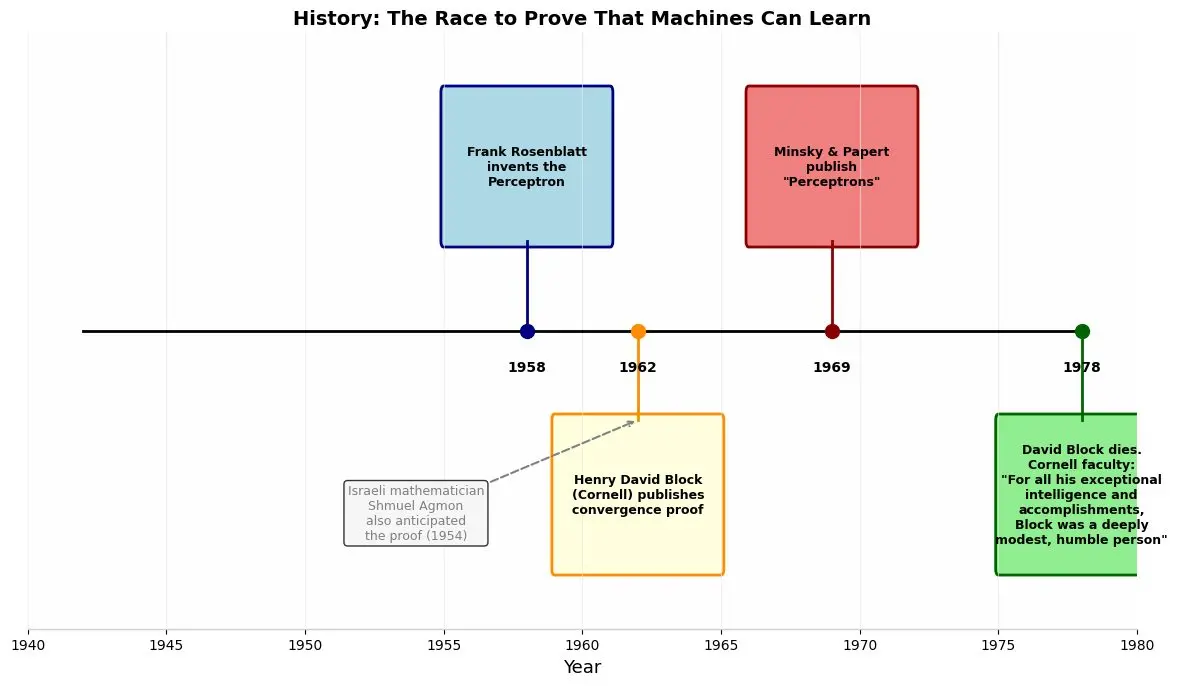
The timeline shows the race to prove that machines can learn. Rosenblatt invented the Perceptron in 1958. Block published the convergence proof in 1962. Minsky and Papert later wrote their famous book "Perceptrons" in 1969.
Here is what happened:
- 1958: Frank Rosenblatt invents the Perceptron. He is excited but does not have a formal proof that it always works.
- 1962: Henry David Block, an applied mathematician at Cornell University, collaborates with Rosenblatt and publishes a proof that establishes upper bounds on the number of mistakes. Block's proof was complicated but correct.
- Before that (1954): Israeli mathematician Shmuel Agmon had actually anticipated both the theorem and the proof, though his work was in abstract mathematics and not widely known in the AI community.
- 1969: Marvin Minsky and Seymour Papert publish their book Perceptrons. They include their own version of the convergence proof, which Block later noted was "precise and elegant" but also "bombastic and occasionally snide."
The book quotes Block's review of Minsky and Papert: "In an abstract mathematical sense, both theorem and proof already existed before the perceptron... It is quite clear that the theorem would have been instantly obvious had the cyberneticists interested in perceptrons known about Agmon's work."
Despite the academic politics, the proof stands as one of the most elegant results in early machine learning. It tells us: learning is not magic. It is mathematics.
6. The Bias Term: A Clever Trick
You may have noticed that the weight vector w has seven elements: [w0, w1, w2, w3, w4, w5, w6], but the patient data has only six features. What is w0?
w0 is the bias term (also called the threshold or intercept). It allows the separating line to NOT pass through the origin. Without a bias, the line would always have to go through the point (0,0), which is too restrictive.
The clever trick? We add a 1 as the first element of every patient vector:
Patient vector: [1, age, BMI, breathing, fever, diabetes, CT]
Now when we calculate wᵀx, the first term is w0 × 1 = w0. This w0 acts as a "free parameter" that shifts the line up or down, left or right, without forcing it through the origin. It is like giving the line the freedom to be anywhere in space, not just passing through zero.
7. Try It Yourself: Python Code
Below is a complete Python program that implements the Perceptron for the pandemic example. It uses pure Python only — no NumPy, no sklearn. You can run this anywhere.
```
python
# ============================================
# PERCEPTRON FOR PANDEMIC PATIENTS
# Pure Python - No Libraries!
# Based on the book's example: predicting ventilator need
# ============================================
def dot_product(a, b):
return sum(x * y for x, y in zip(a, b))
def vector_add(a, b):
return [x + y for x, y in zip(a, b)]
def scalar_multiply(s, v):
return [s * x for x in v]
def perceptron_train(data, labels, max_iterations=100):
"""
The three-step algorithm from the book.
"""
num_features = len(data[0])
w = [0.0] * num_features # Step 1: Start blind
print("=" * 60)
print("PERCEPTRON LEARNING: Pandemic Patient Example")
print("=" * 60)
print("Features per patient: [bias=1, age, BMI, breathing_difficulty, fever, diabetes, CT_scan]")
print("Labels: -1 = No ventilator needed, +1 = Ventilator needed")
print()
print("Step 1: Starting with all weights = 0")
print("-" * 60)
for iteration in range(max_iterations):
updates_done = 0
print(f"\n--- Pass {iteration + 1} over all patients ---")
for i, (x, y) in enumerate(zip(data, labels)):
score = dot_product(w, x)
# Step 2: Check if prediction is correct
if y * score <= 0: # Mistake!
w = vector_add(w, scalar_multiply(y, x))
updates_done += 1
status = "NEEDS VENTILATOR" if y == 1 else "NO VENTILATOR"
print(f" Patient {i+1}: MISTAKE! True: {status}")
print(f" Updating weights... New weights: {[round(v, 2) for v in w]}")
else:
status = "NEEDS VENTILATOR" if y == 1 else "NO VENTILATOR"
print(f" Patient {i+1}: OK ({status})")
# Step 3: Check if done
if updates_done == 0:
print("\n" + "=" * 60)
print(f"SUCCESS! All patients correctly classified after {iteration + 1} passes.")
print("=" * 60)
return w
print(f"\nPass {iteration + 1} complete. Fixed {updates_done} mistakes.")
return w
def predict(w, patient_features):
"""Predict if patient needs ventilator."""
score = dot_product(w, patient_features)
return 1 if score > 0 else -1
# ============================================
# PATIENT DATA (6 features + bias)
# Format: [bias=1, age/100, BMI/50, breathing(0/1), fever(0/1), diabetes(0/1), CT_scan(0/1/2)]
# ============================================
patients = [
# [bias, age, BMI, breathing, fever, diabetes, CT], label
[1.0, 0.45, 0.56, 0, 0, 0, 0], # Young, healthy
[1.0, 0.38, 0.52, 0, 0, 0, 0], # Young, healthy
[1.0, 0.50, 0.60, 0, 0, 0, 0], # Middle-aged, healthy
[1.0, 0.65, 0.64, 1, 1, 0, 1], # Older, breathing issues, fever
[1.0, 0.70, 0.70, 1, 1, 1, 2], # Elderly, multiple symptoms
[1.0, 0.72, 0.68, 1, 1, 1, 2], # Elderly, severe
[1.0, 0.55, 0.58, 0, 1, 0, 0], # Middle, fever only
[1.0, 0.68, 0.66, 1, 0, 1, 1], # Older, diabetes, breathing
]
# Labels: -1 = no ventilator, +1 = needs ventilator
patient_labels = [-1, -1, -1, 1, 1, 1, -1, 1]
# Train
final_weights = perceptron_train(patients, patient_labels)
# Test on new patients
print("\n--- Testing on New Patients ---")
test_patients = [
[1.0, 0.40, 0.54, 0, 0, 0, 0], # Should be healthy
[1.0, 0.75, 0.72, 1, 1, 1, 2], # Should need ventilator
]
for i, patient in enumerate(test_patients):
pred = predict(final_weights, patient)
result = "NEEDS VENTILATOR" if pred == 1 else "NO VENTILATOR needed"
print(f"New Patient {i+1}: Prediction = {result}")
```
When you run this code, you will see the machine start with all zeros, make mistakes on some patients, update its weights, and eventually classify everyone correctly. It is like watching a medical student learn from experience.
8. Summary: What Did We Learn?
Let us wrap up the key ideas from this blog:
- The Perceptron solves real problems. The pandemic example shows how a machine can learn to predict ventilator need from patient data.
- The algorithm is incredibly simple. Three steps: start at zero, check every point, fix mistakes, repeat.
- The update rule has deep meaning. Adding yx to w nudges the decision boundary toward correctness for the mistaken point.
- The convergence proof is a guarantee. The Perceptron is mathematically guaranteed to find a separating line (if one exists) in a finite number of steps. This is not hope — it is proven.
- History matters. Rosenblatt invented it, Block and Agmon proved it, and Minsky & Papert made it famous. The proof was discovered independently by multiple brilliant minds.
- The bias term is a clever trick. Adding a constant 1 to every input allows the line to shift freely, making the algorithm much more powerful.
9. Reference
Anil Ananthaswamy, Why Machines Learn: The Elegant Math Behind Modern AI (2024)
More Machine-Learning tutorials
- Introduction to Machine Learning
- Introduction to Deep Learning
- A Beginner's Guide to Machine Learning
- The First Artificial Neuron and Learning from Mistakes
- Patterns
- Understanding Vectors, the Building Blocks of AI
All tutorials · Try the free PySpark compiler · Practice challenges