CROSS JOIN
Sql tutorial · PySpark.in
7.6 Cross Join
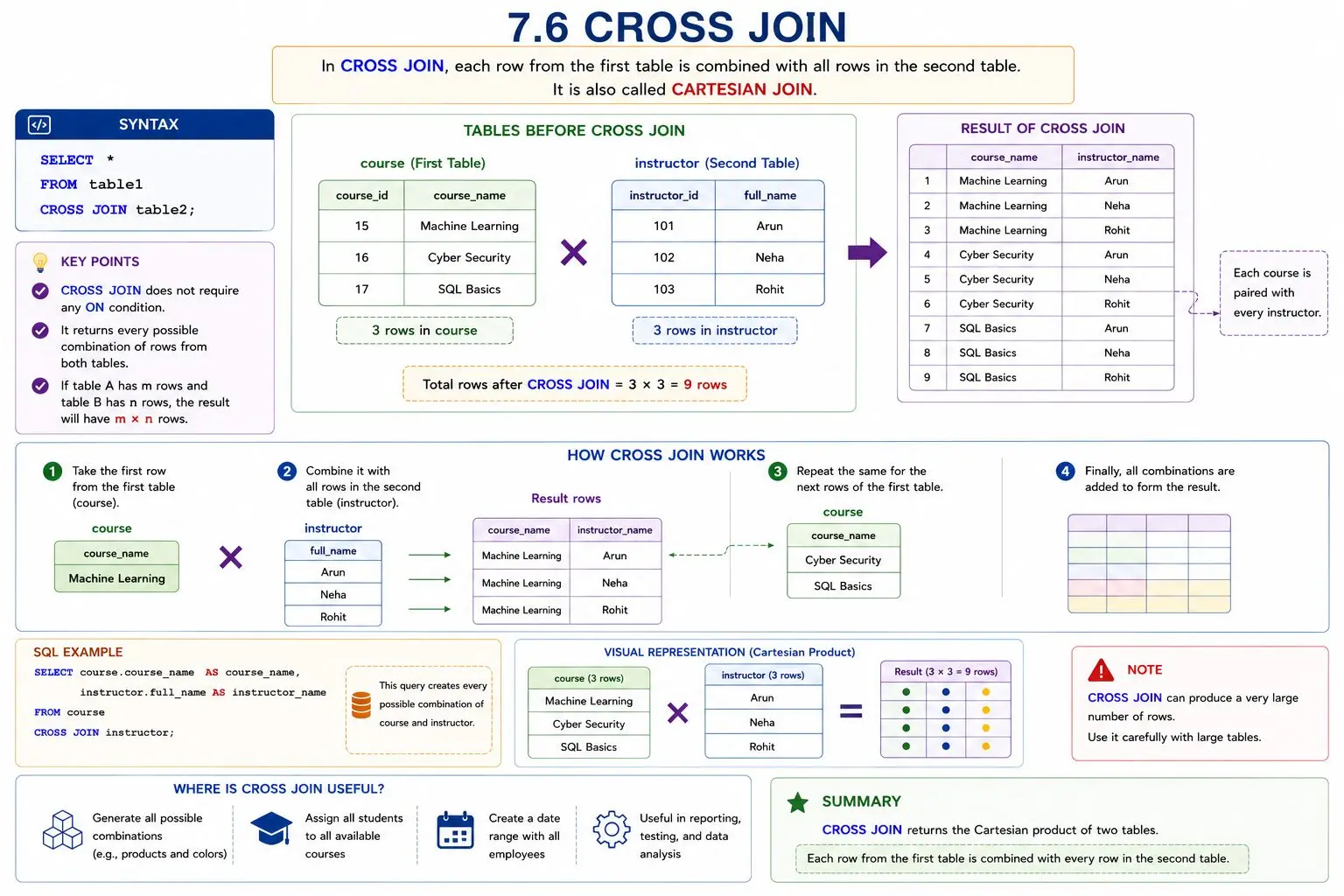
A CROSS JOIN combines every row from the first table with every row from the second table.
It is also called a Cartesian Join because it returns the Cartesian product of the two tables.
In simple words:
Each row of the first table is paired with all rows of the second table.
Unlike other joins, CROSS JOIN does not need a matching condition (ON).
Syntax:
```
hide
sql
SELECT *
FROM table1
CROSS JOIN table2;
```
Example
Perform a CROSS JOIN on the course and instructor tables.
Here:
- the course table contains course names
- the instructor table contains instructor names
A CROSS JOIN creates every possible course–instructor combination.
```
sql
DROP TABLE IF EXISTS course;
DROP TABLE IF EXISTS instructor;
-- Create instructor table
CREATE TABLE instructor (
instructor_id INTEGER PRIMARY KEY,
full_name TEXT
);
-- Create course table
CREATE TABLE course (
course_id INTEGER PRIMARY KEY,
course_name TEXT
);
-- Insert instructors
INSERT INTO instructor (instructor_id, full_name) VALUES
(101, 'Arun'),
(102, 'Neha'),
(103, 'Rohit');
-- Insert courses
INSERT INTO course (course_id, course_name) VALUES
(15, 'Machine Learning'),
(16, 'Cyber Security'),
(17, 'SQL Basics');
-- Perform CROSS JOIN
SELECT course.course_name AS course_name,
instructor.full_name AS instructor_name
FROM course
CROSS JOIN instructor;
```
How It Works
The course table has 3 rows.
The instructor table also has 3 rows.
With a CROSS JOIN:
3 × 3 = 9 rows
That means:
- each course is paired with every instructor
- no matching condition is checked
Important Point
A CROSS JOIN can quickly create a large number of rows.
If:
- table A has 100 rows
- table B has 200 rows
then the result will contain:
100 × 200 = 20,000 rows
So, use CROSS JOIN carefully with large tables.
When Is CROSS JOIN Useful?
A CROSS JOIN is useful when you want to generate all possible combinations, such as:
- all products with all colors
- all students with all available courses
- all dates with all employees
More Sql tutorials
All tutorials · Try the free PySpark compiler · Practice challenges