Core Concepts of ER Model
Sql tutorial · PySpark.in
6. Modeling Databases
Before creating database tables, we first need to understand:
- What data should be stored?
- How different data is connected?
- What relationships exist between data?
Database modeling helps us answer these questions.
One of the most commonly used techniques for database design is the:
ER Model (Entity Relationship Model)
The ER Model represents:
- Entities
- Attributes
- Relationships
between real-world objects.
It acts as a blueprint for designing databases.
6.1 Core Concepts in ER Model
The ER Model consists of several important concepts.
Entity
A real-world object or concept is called an Entity.
Entities can be:
- Physical objects
- People
- Places
- Events
- Organizations
Examples of Entities
Real World Object | Entity |
|---|---|
Student | Student |
Employee | Employee |
Product | Product |
Company | Company |
Real-Life Examples
John
Emma
Apple
Google
Each of these represents a real-world object, so they are entities.
Attributes of an Entity
Attributes are the properties or characteristics of an entity.
They describe the entity.
Example
Consider a Student entity.
Attribute | Value |
|---|---|
name | John |
age | 29 |
city | Delhi |
Here:
- name
- age
- city
are attributes of the Student entity.
Another Example
name | age |
|---|---|
Emma | 25 |
Attributes:
name
age
Key Attribute
A key attribute uniquely identifies each entity.
No two entities can have the same key value.
Example
Consider the Student entity:
student_id | name | age |
|---|---|---|
101 | John | 29 |
102 | Emma | 25 |
Here:
student_id
is the key attribute because it uniquely identifies every student.
Why Key Attributes Are Important
Key attributes help us:
- Avoid duplicate records
- Identify rows uniquely
- Connect tables using relationships
Entity Type
An Entity Type is a collection of entities having the same attributes.
Example
Entity Type: Student
student_id | name | age |
|---|---|---|
101 | John | 29 |
102 | Emma | 25 |
103 | David | 30 |
All students have the same attributes:
student_id
name
age
Therefore, they belong to the same entity type: Student.
Relationships
A relationship represents an association between entities.
Relationships show how entities are connected.
Example
Consider:
- Customer
- Order
A customer places orders.
So:
Customer → places → Order
This association is called a relationship.
Types of Relationships
Relationships are classified based on how many entities are associated.
1. One-to-One Relationship (1:1)
In a One-to-One relationship:
- One entity is associated with only one entity
- Vice versa is also true
Example: Person and Passport
One Person → One Passport
One Passport → One Person
Diagram

Real-Life Examples
- Person ↔ Passport
- Country ↔ Capital
- Employee ↔ Locker
2. One-to-Many Relationship (1:M)
In a One-to-Many relationship:
- One entity can be related to many entities
- But each child entity belongs to only one parent entity
Example: Person and Cars
One Person → Many Cars
One Car → One Person
Diagram

Real-Life Examples
- Customer → Orders
- Department → Employees
- Teacher → Students
3. Many-to-Many Relationship (M:N)
In a Many-to-Many relationship:
- Multiple entities are related to multiple entities
Example: Students and Courses
One Student → Many Courses
One Course → Many Students
Diagram

Real-Life Examples
- Students ↔ Courses
- Actors ↔ Movies
- Products ↔ Orders
Cardinality Ratio
Cardinality defines the maximum number of relationships between entities.
It describes:
How many instances of one entity
can relate to another entity
Types of Cardinality
Cardinality | Meaning |
|---|---|
1:1 | One-to-One |
1:M | One-to-Many |
M:1 | Many-to-One |
M:N | Many-to-Many |
Understanding Cardinality
1:1 Relationship
One Employee → One Locker
1:M Relationship
One Customer → Many Orders
M:1 Relationship
Many Employees → One Department
M:N Relationship
Many Students ↔ Many Courses
Applying ER Model Concepts
Let us understand ER modeling using a real-world application.
Example: E-Commerce Application
An e-commerce application contains entities such as:
- Customers
- Products
- Carts
- Addresses
Entity Types
Entity Type | Description |
|---|---|
Customer | Application users |
Product | Products sold online |
Cart | Shopping cart |
Address | Delivery addresses |
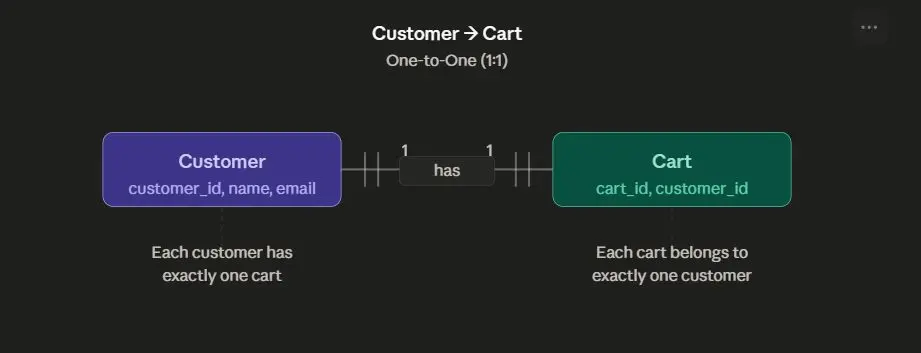
Relationship 1 — Customer and Cart
A customer has only one cart.
A cart belongs to only one customer.
Relationship Type
Customer → Cart = One-to-One (1:1)
Diagram
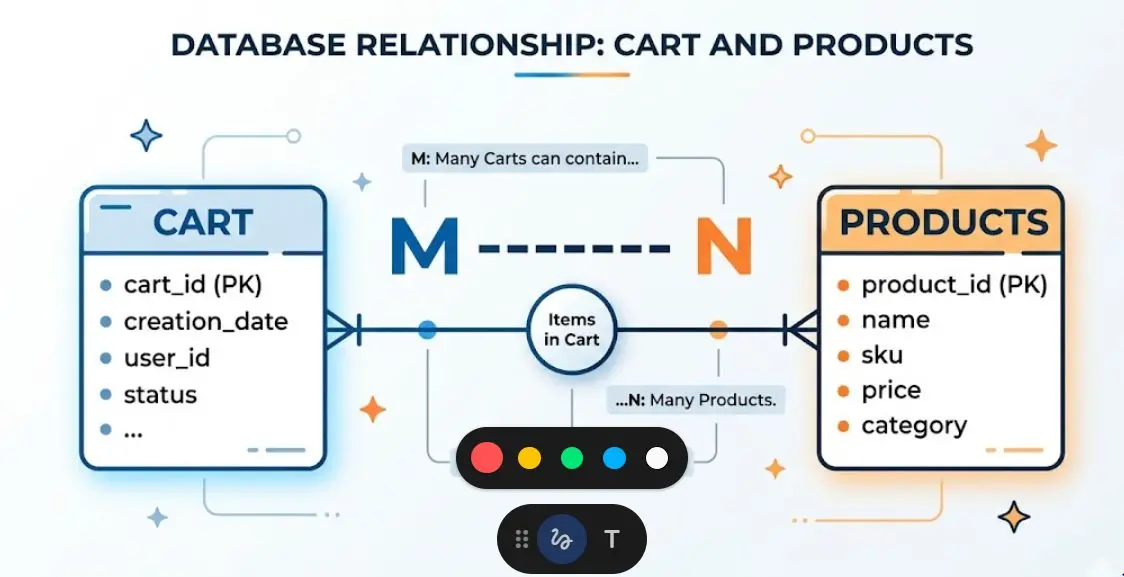
Relationship 2 — Cart and Products
A cart can contain many products.
A product can exist in many carts.
Relationship Type
Cart → Products = Many-to-Many (M:N)
Diagram
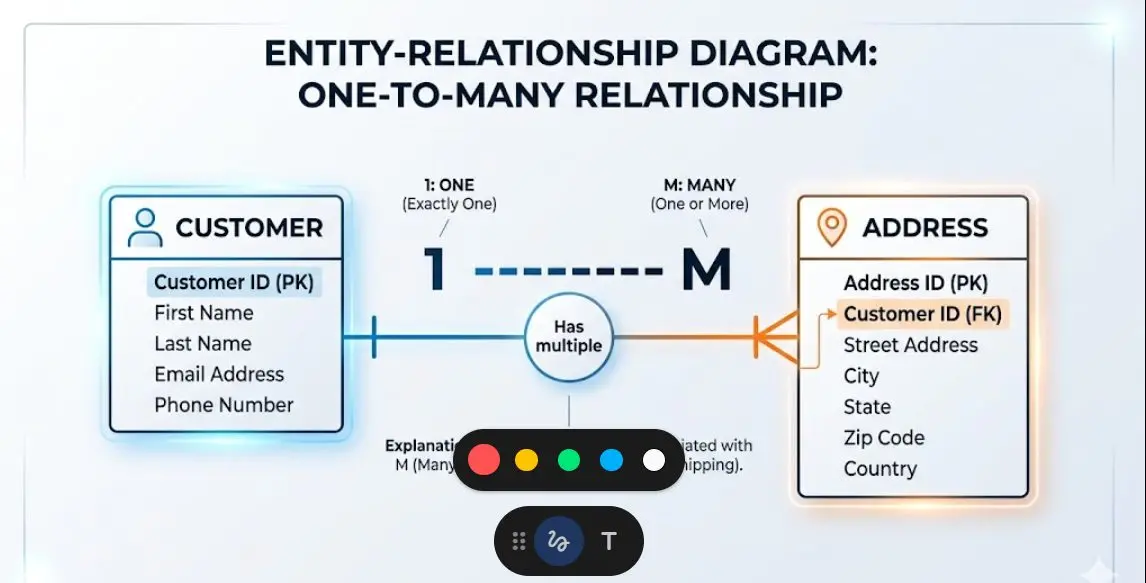
Relationship 3 — Customer and Address
A customer can save multiple addresses.
Each address belongs to one customer.
Relationship Type
Customer → Address = One-to-Many (1:M)
Diagram
ER Model Summary for E-Commerce Application
Entity | Relationship | Entity | Type |
|---|---|---|---|
Customer | owns | Cart | 1:1 |
Cart | contains | Product | M:N |
Customer | saves | Address | 1:M |
Why ER Modeling Is Important
ER modeling helps us:
- Design databases properly
- Identify entities and relationships
- Reduce redundancy
- Improve data organization
- Create scalable database structures
More Sql tutorials
All tutorials · Try the free PySpark compiler · Practice challenges