Introduction to Databases
Sql tutorial · PySpark.in
What Is Data?
Any information that can be stored is called data.
We use data every day in different applications and systems.
Examples of Data
- Messages, photos, and videos on WhatsApp
- Products, customers, and orders on Amazon
- Contact details stored in a phone directory
- Student records in schools and colleges
- Banking transactions in banking systems
What Is a Database?
A database is an organized collection of data.
Instead of storing information randomly, databases arrange the data properly so it can be:
- Stored efficiently
- Accessed quickly
- Updated easily
- Managed securely
Real-World Example
Imagine a school storing:
- Student details
- Teacher information
- Exam marks
- Attendance records
If everything is stored in notebooks, searching becomes difficult.
A database stores all this information in an organized manner.
What Is DBMS?
DBMS (Database Management System)
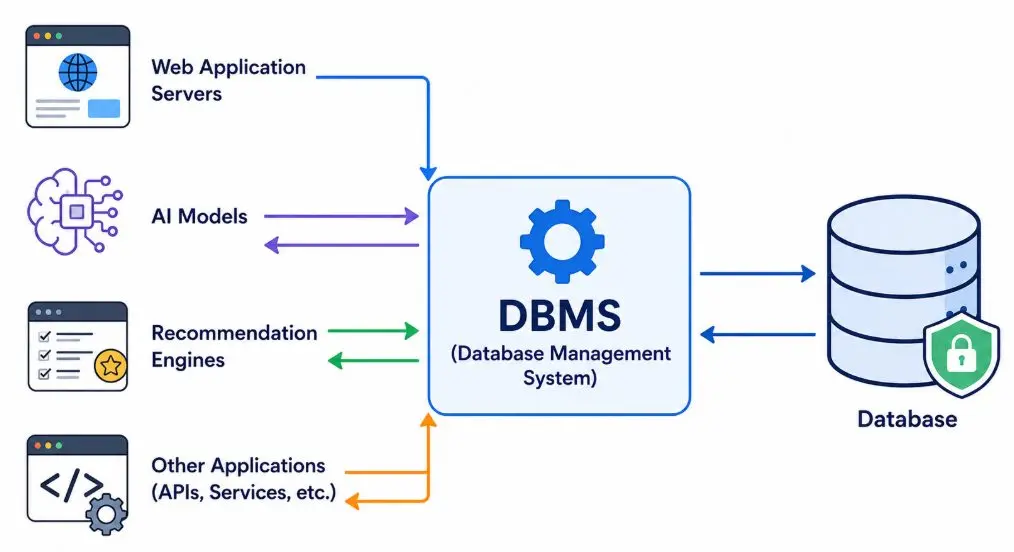
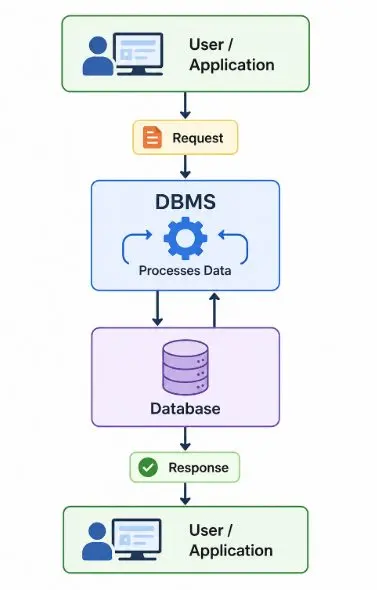
A DBMS is software used to store, manage, retrieve, and secure data inside a database.
It acts as a bridge between users/applications and the database.
Simple DBMS Architecture
How DBMS Works
Advantages of DBMS
1. Security
DBMS keeps data secure and prevents unauthorized access.
Example
Only bank employees can access customer account details.
2. Ease of Use
DBMS makes it easy to:
- Insert data
- Update data
- Delete data
- Search data
3. Durability and Availability
Data remains safe even after system failures and is available whenever needed.
Example
ATM systems work 24/7 because databases are continuously available.
4. Performance
DBMS provides fast access to data even when millions of records are stored.
Example
Searching a product on Amazon takes only a few seconds.
Types of Databases
Databases are classified based on how data is stored and organized.
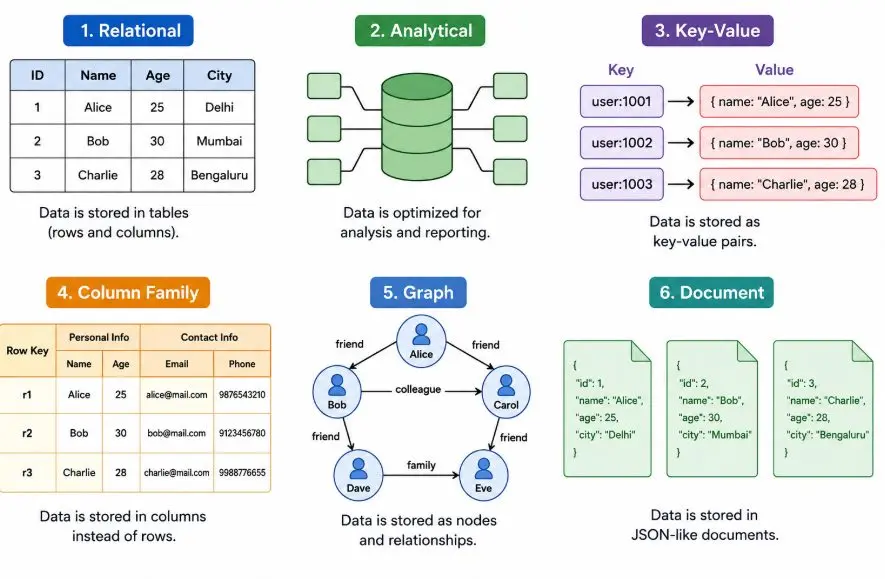
Databases
│
├── Relational Database
│
└── Non-Relational Database
├── Key-Value
├── Document
├── Column Family
└── Graph
Relational Database
In a Relational Database, data is stored in the form of tables.
Each table contains:
- Rows → Records
- Columns → Fields
Example of Relational Database Table
Student Table
student_id | student_name | course |
|---|---|---|
1 | Rahul | SQL |
2 | Priya | Python |
3 | Amit | Spark |
Features of Relational Databases
- Data stored in tables
- Easy to understand
- Supports relationships between tables
- Uses SQL language
Examples of Relational DBMS
- Oracle Database
- PostgreSQL
- MySQL
- SQLite
- Microsoft SQL Server
- IBM Db2
Non-Relational Database (NoSQL)
Non-relational databases store data in non-tabular formats.
They are commonly used for:
- Big data
- Real-time applications
- Flexible and rapidly changing data
Types of Non-Relational Databases
1. Key-Value Database
Data is stored as:
Key -> Value
Example
101 -> Rahul
102 -> Priya
Example DBMS
- Redis
- Amazon DynamoDB
2. Document Database
Stores data in JSON-like documents.
Example
{
"name": "Rahul",
"course": "SQL"
}
Example DBMS
- MongoDB
- CouchDB
3. Column Family Database
Stores data in columns instead of rows.
Used for handling huge amounts of data.
Example DBMS
- Apache Cassandra
4. Graph Database
Stores data in the form of nodes and relationships.
Used in:
- Social networks
- Recommendation systems
- Fraud detection
Example DBMS
- Neo4j
Relational vs Non-Relational Database
Feature | Relational Database | Non-Relational Database |
|---|---|---|
Structure | Tables | Flexible formats |
Schema | Fixed | Dynamic |
Language | SQL | Different APIs/queries |
Best For | Structured data | Unstructured/semi-structured data |
Scalability | Vertical scaling | Horizontal scaling |
Important Notes
- Choice of database depends on project requirements.
- Relational databases are the most commonly used databases.
- Non-relational databases are popular in big data and modern web applications.
Summary
Topic | Description |
|---|---|
Data | Raw information |
Database | Organized collection of data |
DBMS | Software to manage databases |
Relational Database | Data stored in tables |
Non-Relational Database | Data stored in flexible formats |
RDBMS | DBMS for relational databases |
More Sql tutorials
All tutorials · Try the free PySpark compiler · Practice challenges