Data Engineering: Essential Concepts Explained
Spark tutorial · PySpark.in
17. Apache Kafka Fundamentals:
- Distributed event streaming platform
- High throughput, fault tolerant, scalable
- Uses topics to publish/subscribe messages
- Key Concepts:
- Producer – Publishes messages to topics
- Consumer Group – Consumes messages
- Topic – Logical channel
- Partition – Parallelism within topic
- Offset – Position of message in partition
- Broker – Kafka server
- Zookeeper / KRaft – Cluster coordination
Kafka Components | Description |
|---|---|
Producer | Sends data to Kafka topics |
Topic | Category/feed name to store records |
Partition | Sub-division of topic for parallelism |
Broker | Kafka server that stores data |
Consumer | Reads data from topics |
Consumer Group | Group of consumers working together |
Offset | Unique ID of message in a partition |
Zookeeper/KRaft | Manages and coordinates brokers |
18. Data Ingestion Patterns:
Batch Ingestion:
- Data collected in batches (e.g. hourly, daily)
- Loaded to storage/warehouse
- Use cases: Reports, ETL jobs, historical analysis
- Tools: Sqoop, NiFi, Airflow, ADF
Streaming Ingestion:
- Data captured and processed in real-time
- Low latency, continuous flow
- Use cases: Fraud detection, IoT, monitoring
- Tools: Kafka, NiFi, Spark Streaming, Flink
19. Data Lake vs Data Warehouse:
Aspect | Data Lake | Data Warehouse |
|---|---|---|
Purpose | Store all types of raw data | Store structured, processed data |
Schema | Schema on read | Schema on write |
Data Types | Structured, Semi-structured, Unstructured | Structured |
Storage | Cheaper storage (HDFS, S3, ADLS, GCS) | Optimized storage (Snowflake, Redshift, BigQuery) |
Processing | Big data processing frameworks | Fast SQL queries, Analytics |
Quality | Raw, less quality checks | High quality, transformations performed |
Use Cases | Exploration, ML, Data Science | Reporting, BI, Dashboards |
Examples | S3, ADLS, HDFS, GCS | Snowflake, Redshift, BigQuery, Synapse |
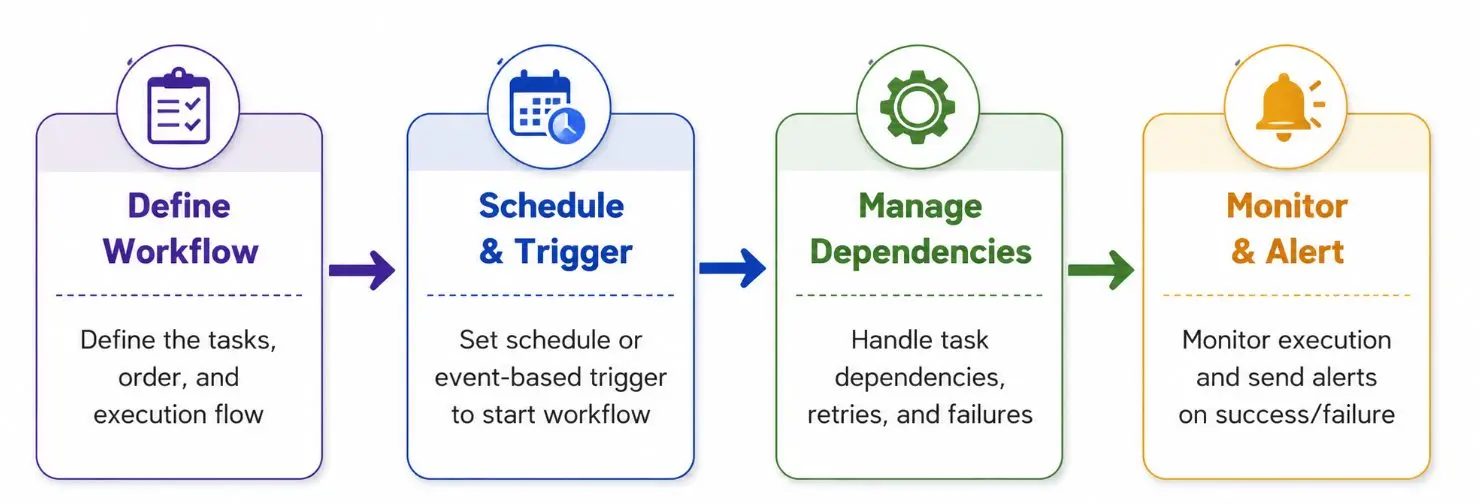
20. Data Orchestration Tools:
- Apache Airflow – Open source workflow scheduler
- Azure Data Factory – Cloud ETL/ELT orchestration
- Apache Oozie – Workflow scheduler for Hadoop
- Prefect – Modern workflow orchestration
- Luigi – Python based pipeline tool
Define Workflow → Schedule & Trigger → Manage Dependencies → Monitor & Alert
21. Data Engineering Best Practices
- Design for scalability and reusability
- Automate everything (pipelines, tests, deployments)
- Implement data validation at every stage
- Use partitioning and indexing for performance
- Practice metadata and data lineage
- Follow naming conventions and documentation
- Implement monitoring, logging and alerting
- Handle errors and retries gracefully
- Ensure security and access control
- Optimize costs (storage, compute)
- Version control code and configurations
- Regularly audit and improve data quality
22. Data Governance & Security :
- Data Governance ensures data is trustworthy, compliant and secure
- Key Components:
- Data Ownership – Define who owns the data
- Data Classification – PII, Sensitive, Confidential, Public
- Access Control – RBAC, IAM policies
- Data Lineage – Track data flow and transformations
- Compliance – GDPR, HIPAA, CCPA, ISO
Security Measures:
- Encryption at rest and in transit
- Network security (VPC, Private Link)
- Identity management (IAM, Azure AD, AWS Identity Manager)
- Audit logs and monitoring
- Backup and disaster recovery
23. Important SQL for Data Engineers :
Category | Important SQL | Category | Important SQL |
|---|---|---|---|
Data Retrieval | SELECT, WHERE, ORDER BY, LIMIT | Set Operations | UNION, UNION ALL, INTERSECT, EXCEPT |
Joins | INNER JOIN, LEFT JOIN, RIGHT JOIN, FULL OUTER JOIN | Subqueries | Subquery in SELECT, FROM, WHERE |
Filtering | IN, BETWEEN, LIKE, IS NULL | CTE | WITH clause (Common Table Expression) |
Aggregation | GROUP BY, HAVING, SUM(), COUNT(), AVG(), MIN(), MAX() | Data Modification | INSERT, UPDATE, DELETE, MERGE |
Window Functions | ROW_NUMBER(), RANK(), DENSE_RANK(), LAG(), LEAD(), NTILE() | DDL | CREATE, ALTER, DROP, TRUNCATE |
24. Cloud Platforms for Data Engineering :
AWS | Azure | GCP | |
|---|---|---|---|
Storage | S3, Glacier | ADLS Gen2, Blob Storage | GCS |
Compute | EC2, EMR, ECS | Azure VM, AKS, Azure Databricks | Compute Engine, GKE, Dataproc |
Database | RDS, Redshift, DynamoDB | Azure SQL, Cosmos DB, Synapse | BigQuery, Cloud SQL, Firestore |
Processing | EMR (Spark, Hive), Glue | Processing: Databricks, HDInsight (Spark) | Dataproc (Spark, Hive), Dataflow |
Streaming | Kinesis (Streams, Firehose) | Event Hubs, Stream Analytics | Pub/Sub, Dataflow (Streaming) |
Orchestration | Step Functions, MWAA (Airflow) | Data Factory, Synapse Pipelines | Cloud Composer (Airflow) |
Analytics | Athena, QuickSight | Synapse Analytics, Power BI | BigQuery, Looker Studio |
Data Integration | AWS Data Pipeline, Glue | Azure Data Factory | Data Integration, Data Fusion |
Monitoring | CloudWatch | Azure Monitor | Cloud Monitoring |
IaC | CloudFormation | ARM Templates, Bicep | Terraform, Deployment Manager |
25. Data Engineering Interview Q&A:
- Q1. What is the difference between Data Lake and Data Warehouse?
- Ans: Data Lake stores raw data in any format at low cost. Data Warehouse stores processed, structured data optimized for analytics.
- Q2. What is the difference between ETL and ELT?
- Ans: ETL – Transform data before loading to target. ELT – Load data first, then transform in target system.
- Q3. What is idempotency in data pipelines?
- Ans: A property where processing the same data multiple times produces the same result without side effects.
- Q4. What is data partitioning?
- Ans: Dividing large data into smaller chunks based on a key/column to improve performance.
- Q5. What is schema evolution?
- Ans: The ability to evolve the schema of data (add/modify columns) without breaking the pipeline.
- Q6. What is eventual consistency?
- Ans: A consistency model where systems will become consistent over time, not immediately.
26. End-to-End Data Engineering Pipeline Example:
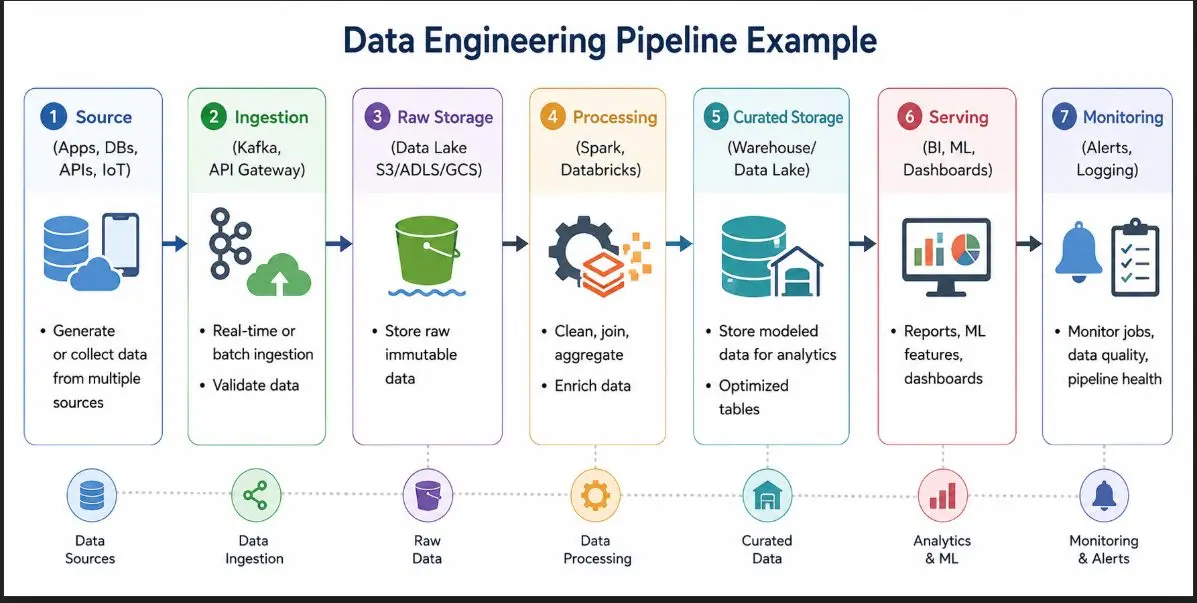
- Generate or collect data
- Real-time or batch ingestion + Validate data
- Store raw, immutable data
- Clean, join, aggregate, Enrich data
- Store modeled data for analytics + Optimized tables
- Reports, ML features, dashboards
- Monitor jobs, data quality, pipeline health
27. Data Engineering Career Roadmap :
1. Foundation | 2. Databases | 3. Core DE Skills | 4. Big Data Tools | 5. Cloud & DW | 6. Advanced | 7. Leadership |
|---|---|---|---|---|---|---|
SQL, Linux, Python, Git, Data Structures | RDBMS, NoSQL, Data Modeling, Indexing | ETL/ELT, Pipelines, Orchestration, Batch & Streaming | Spark, Hadoop, Kafka, Airflow, Databricks | AWS/Azure/GCP, Snowflake/Redshift/BigQuery/Synapse | Data Modeling, Data Governance, Data Quality | Design, System, Optimize Cost, Mentor, Scale |
Keep Building Projects → Learn → Practice → Contribute → Grow
28. Common Data Engineering Metrics Ans:
Metric | Description | How to Measure | Why it Matters |
|---|---|---|---|
Data Freshness | How recent the data is | Time since last update | Ensures up-to-date insights |
Pipeline Success Rate | % of successful pipeline runs | (Successful runs / Total runs) * 100 | Measures reliability |
Data Volume | Amount of data processing | Total records/GB/TB | Helps capacity planning |
Processing Latency | Time taken to process data | End Time – Start Time | Affects timeliness |
Data Quality Score | Quality of data | % of valid records | Ensures trust in data |
Cost per TB | Cost to store & process data | Total cost / TB processed | Helps optimize costs |
Resource Utilization | CPU, Memory, Storage usage | Cloud monitoring tools | Helps optimize resources |
Job Failure Rate | % of failed jobs | (Failed jobs / Total jobs) * 100 | Indicates stability issues |
29. Quick Revision – Key Concepts Ans:
Concept | In One Line |
|---|---|
Data Engineering | Builds the foundation for data to be used in analytics and ML |
Pipeline | Workflow that move data from source to destination |
Data Lake | Store any type of data in raw format at scale |
Data Warehouse | Store structured, processed data for analytics |
ETL / ELT | ETL transforms first, ELT loads first then transforms |
Batch Processing | Process large volumes at scheduled intervals |
Streaming | Process data in real-time as it is generated |
Orchestration | Schedule, monitor and manage data workflows |
Data Quality | Ensure accuracy, completeness, consistency and validity |
Partitioning & Indexing | Improve performance, query speed |
Security & Governance | Protect data and ensure compliance and proper access |
Scalability | Handle growing data volumes and users efficiently |
30. Cheat Sheet – Data Engineering Commands Ans:
Linux Commands:
- ls – List files
- cd – Change directory
- pwd – Print working directory
- rm – Remove files
- cp – Copy files
- mv – Move files
- cat – View file
- grep – Search text
- wc – Count lines/words
HDFS Commands:
- hdfs dfs -ls /path
- hdfs dfs -put local /path
- hdfs dfs -get /path /local
- hdfs dfs -mkdir /path
- hdfs dfs -cat /path/file
- hdfs dfs -rm /path
- hdfs dfs -du -h /path
Spark Commands (PySpark):
- spark.read.load(path)
- df.show()
- df.printSchema()
- df.select('col').show()
- df.filter(df.col > 10)
- df.groupBy('col').count()
- df.write.mode("overwrite")
- parquet(path)
SQL Quick Commands:
- SELECT * FROM table
- WHERE, GROUP BY, HAVING
- ORDER BY, LIMIT
- INNER, LEFT, RIGHT, FULL
- UNION, UNION ALL
- INSERT, UPDATE, DELETE
- CREATE, DROP, ALTER
31. End-to-End Real World Example – E-commerce Analytics:
1. Data Sources (Website, App, Payment, Logs) → 2. Ingestion (Kafka / API / Logs) → 3. Storage (Data Lake S3 / ADLS / GCS) → 4. Processing (Spark) → 5. Warehouse (Snowflake / Redshift / BigQuery) → 6. Analytics (BI Tools)
- Generate raw data
- Capture data in real-time / batch
- Store raw data in scalable storage
- Clean, transform, aggregate data
- Store processed, structured data
- Dashboards, Reports, Insights
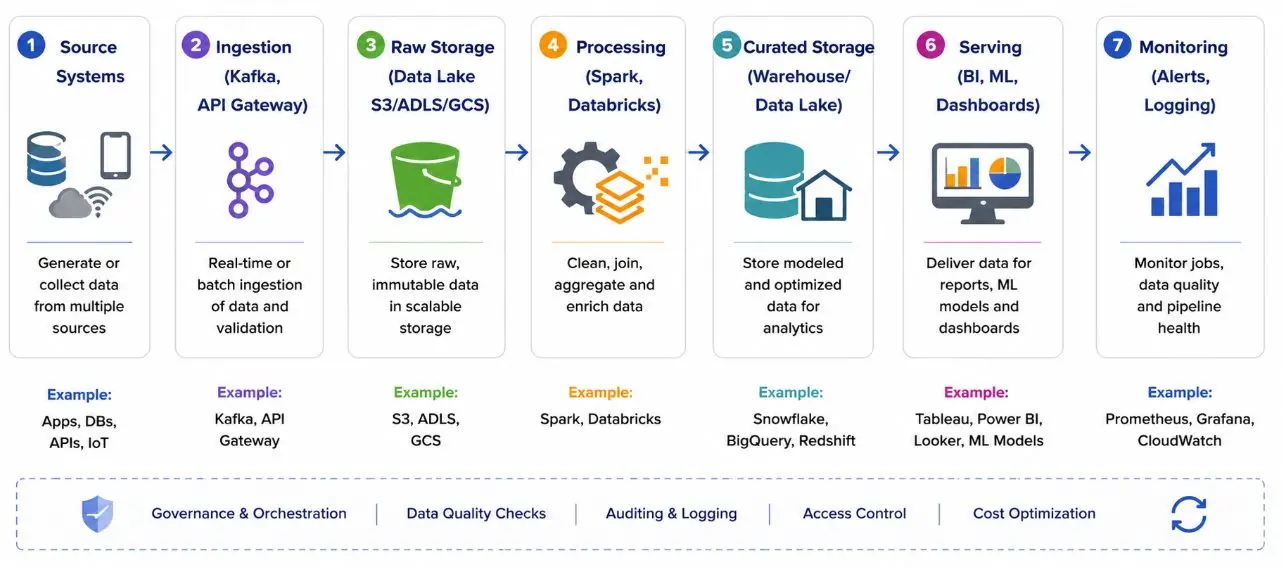
7. Monitoring & Orchestration – Airflow, CloudWatch, Datadog, Slack Alerts
32. Common Data Engineering Projects Ideas :
- Real-time Uber / Ola ride data pipeline
- Real-time E-commerce data pipeline
- Stock market data streaming pipeline
- Social media analytics pipeline
- IoT sensor data pipeline
- Clickstream data pipeline for website analytics
- Data warehouse for sales & finance analytics
- Data lake + lakehouse on cloud
- Build ETL/ELT framework with orchestration
Project Structure:
- Problem Statement
- Data Sources
- Architecture Diagram
- Tech Stack
- Data Pipeline
- Testing & Monitoring
- Insights / Dashboard
- Learnings
More Spark tutorials
- about pyspark
- text diagram
- Apache Spark Runtime Architecture
- Introduction to RDD
- Actions vs Transformations
- Lazy Evaluation in PySpark
All tutorials · Try the free PySpark compiler · Practice challenges