Data Engineering Foundations and Core Concepts
Spark tutorial · PySpark.in
1. What is Data Engineering?
Data Engineering is the practice of designing, building, testing and maintaining the infrastructure and systems that collect, store, process and make data available for analytics, machine learning and business intelligence.
2. Goals of Data Engineering:
- Ingest data from multiple and diverse sources
- Build reliable and scalable data pipelines
- Store data efficiently and cost-effectively
- Transform data into useful and trusted formats
- Ensure data quality, consistency and reliability
- Make data accessible for analysis and ML
- Automate, monitor and optimize data workflows
3. Key Components of Data Engineering:
Component | Purpose |
|---|---|
Data Ingestion | Collect data from various sources (Batch / Streaming) |
Data Storage | Store raw and processed data (Data Lake / Warehouse / DB) |
Data Processing | Clean, transform and enrich data |
Orchestration | Schedule, automate and monitor data workflows |
Data Quality | Validate, test and ensure accuracy and consistency |
Serving Layer | Provide data for analytics, ML, dashboards, reports |
Governance & Security | Manage access, lineage, catalog, compliance and security |
4. Types of Data:
By Structure:
- Structured – Rows & columns (SQL DB)
- Semi-structured – JSON, XML, Logs
- Unstructured – Text, Images, Videos, Audio
By Processing:
- Batch Data – Processed in chunks at intervals
- Streaming Data – Real-time continuous data
5. Common Data Sources:
- Databases (MySQL, PostgreSQL, SQL Server, Oracle)
- Files (CSV, JSON, Parquet, Avro)
- Streams & Clickstreams
- IoT Devices & Sensors
- Applications (CRM, ERP, SaaS)
- APIs & Web Services
- Third Party Data Providers
6. Data Engineering Workflow (High Level):
Source Systems → Ingestion (Extract) → Storage (Data Lake) → Processing (Transform) → Serving (Analytics / ML) → Monitoring & Optimization
- Source Systems: Data from apps, databases, files, APIs, devices
- Ingestion: Collect data in batch or real-time
- Storage: Store raw data in scalable storage
- Processing: Clean, join, aggregate, enrich data
- Serving: Make data available for reports, ML, BI
- Monitoring: Monitor pipelines, quality, costs and performance
7. Data Storage Options Ans:
Storage Type | Examples | Use Cases | Pros | Cons |
|---|---|---|---|---|
Relational DB | MySQL, PostgreSQL, SQL Server | OLTP, Transactions, Operational Data | ACID compliant, Structured, Reliable | Not good for big data, Less flexible |
Data Warehouse | Snowflake, BigQuery, Redshift, Synapse | Analytics, Reporting, BI | Optimized for ML, Scalable, SQL support | Expensive for raw data, Requires modeling |
Data Lake | AWS S3, ADLS, GCS, HDFS | Raw data storage, ML, Exploration | Low cost, Scalable, Stores any format | No schema enforcement, Needs processing |
NoSQL DB | MongoDB, Cassandra, DynamoDB | High volume, Unstructured, Real-time apps | Flexible schema, High availability | Limited joins, Eventual consistency |
Object Storage | Amazon S3, Azure Blob | Backup, Archive, Data Lake | Durable, Low cost, Highly scalable | Not for direct querying |
8. Data Formats Ans:
- CSV – Simple, human readable
- JSON / XML – Semi-structured, flexible
- Parquet – Columnar, compressed, fast for analytics
- Avro – Row based, schema evolution
- ORC – Optimized for Hadoop ecosystem
- Delta / Iceberg / Hudi – ACID, Time travel, Upserts
9. Batch vs Streaming Ans:
Batch Processing | Streaming Processing | ||||||||||||||||||||||||||||
|---|---|---|---|---|---|---|---|---|---|---|---|---|---|---|---|---|---|---|---|---|---|---|---|---|---|---|---|---|---|
Process data in chunks at scheduled intervals | Process data in real-time as it is generated | ||||||||||||||||||||||||||||
Higher latency (minutes to hours) | Low latency (seconds to milliseconds) | ||||||||||||||||||||||||||||
Simpler to implement | Requires state management | ||||||||||||||||||||||||||||
Use cases: Reports, ETL jobs, Historical analysis | Use cases: Fraud detection, Real-time dashboards | ||||||||||||||||||||||||||||
Tools: Airflow, Spark (Batch) | Tools: Kafka, Spark Streaming, Flink, Kinesis | ||||||||||||||||||||||||||||
10. ETL vs ELT Ans:
11. OLTP vs OLAP Ans:
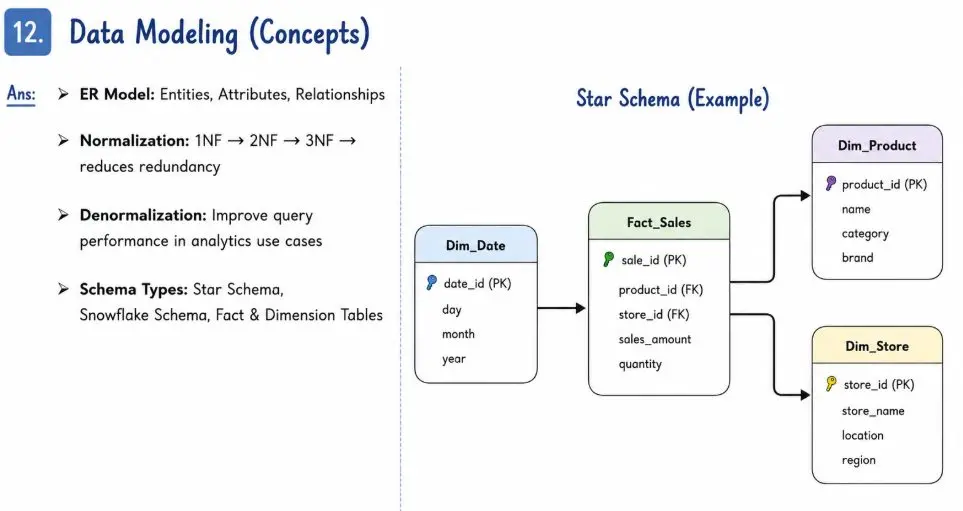
12. Data Modeling (Concepts) Ans:
Star Schema (Example)
13. Data Quality & Best Practices Ans:
14. Data Partitioning & Indexing Ans: Partitioning (Improve performance):
Indexing (Speed up queries):
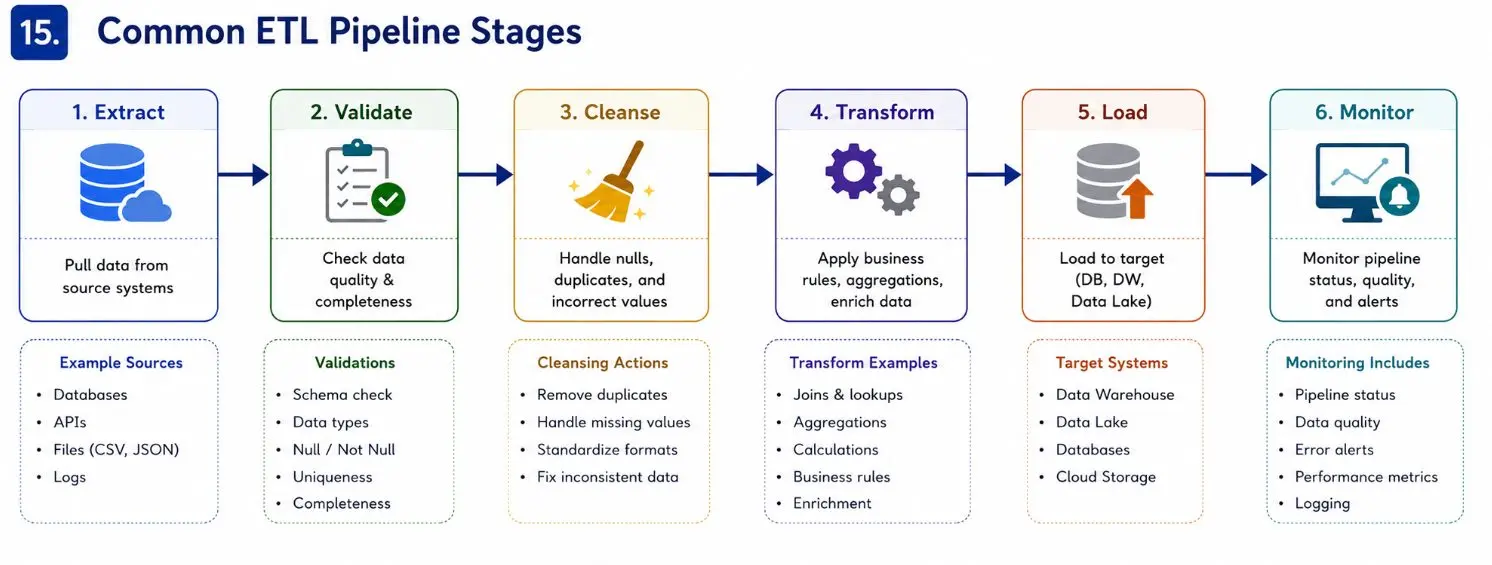
15. Common ETL Pipeline Stages Ans: Extract → Validate → Cleanse → Transform → Load → Monitor
16. Apache Spark Fundamentals Ans:
|
More Spark tutorials
- about pyspark
- text diagram
- Apache Spark Runtime Architecture
- Introduction to RDD
- Actions vs Transformations
- Lazy Evaluation in PySpark
All tutorials · Try the free PySpark compiler · Practice challenges