Orchestration Tools
Spark tutorial · PySpark.in
Orchestration Tools
In an ETL pipeline, it’s not enough to just extract, transform, and load data — you
also need a way to organize, schedule, and monitor these steps so they run reliably.
That’s where orchestration tools come in. Think of them as the “project managers”
of ETL pipelines:
Scheduling: Decide when jobs run (hourly, daily, real-time).
Automation: Make sure jobs run automatically without manual effort.
Dependencies: Ensure steps happen in the right order (you can’t transform
before extraction).
Monitoring: Keep track of success/failure, send alerts if something breaks.
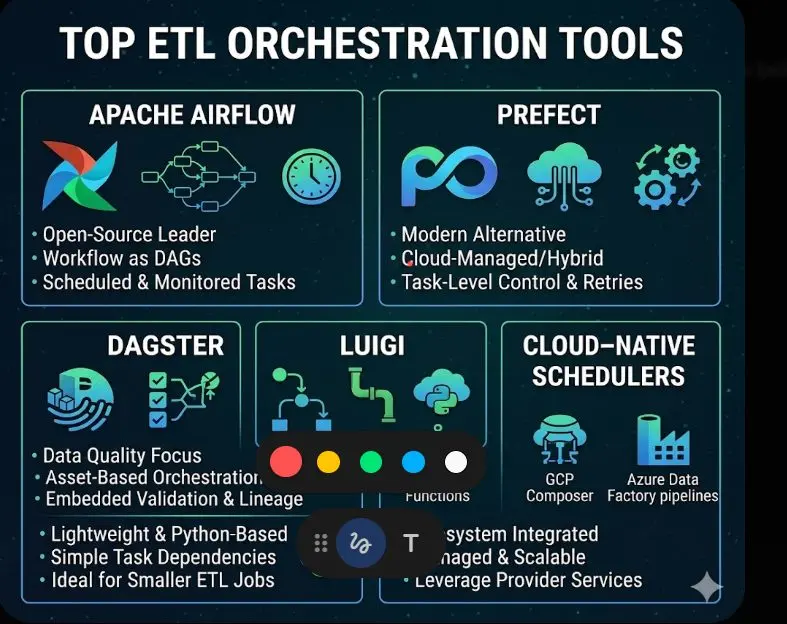
Apache Airflow
- Most widely used open-source orchestration tool.
- Defines workflows as DAGs (Directed Acyclic Graphs).
Example: Schedule “extract sales - transform in Spark - load Example: into Redshift.”
Prefect:
- Modern alternative to Airflow with easier deployment.
- Cloud-managed or open-source.
Example: Manage 1,000+ daily ETL tasks with retries and alerts.
Dagster
- Orchestration tool with strong focus on data quality & lineage.
Example: Enforce schema validation while scheduling transformations.
Luigi
- Lightweight Python-based orchestration.
- Example: Automating smaller ETL jobs like daily CSV ingestion → SQLite load.
Cloud-Native Schedulers:
- AWS Step Functions, GCP Composer (managed Airflow), Azure Data Factory
pipelines.
- Great for teams already tied to specific cloud ecosystems.
Monitoring & Data Quality Tools
Pipelines break — monitoring ensures reliability and data trust.
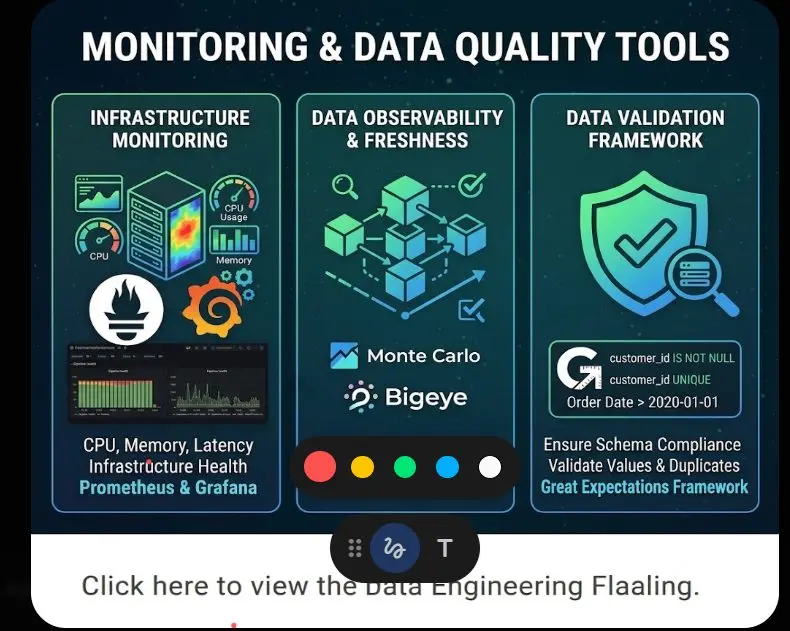
Prometheus + Grafana
- Monitor ETL infrastructure (CPU, memory, latency).
- Grafana dashboards show pipeline health.
Monte Carlo, Bigeye, Datafold
- Specialized “data observability” platforms.
- Track lineage, anomalies, and ensure data freshness.
Great Expectations
- Open-source framework for data validation.
Example: Ensure “customer_id” is never Example: null or duplicated.
Best Practice for ETL Pipeline
ETL pipelines are not just technical scripts, they are the nervous system of datadriven
companies. Designing them well ensures scalability, trust, and business
impact. Below are the core best practices explained with theory + real-world use
cases.
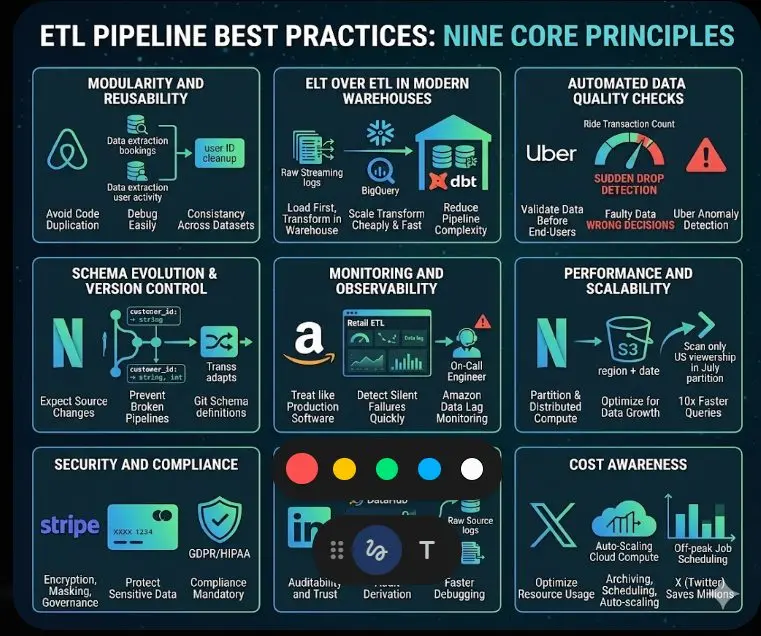
Modularity and Reusability
Principle: Design ETL pipelines as separate modules (extract, transform, load)
rather than one monolithic job.
Why it Matters: Modularity makes it easier to debug, maintain, and reuse
components across different datasets.
Use Case:
a. Airbnb extracts booking data and user activity separately but applies
reusable “user ID cleanup” transformations in both pipelines.
b. This avoids duplicate code and ensures consistency across datasets.
ELT over ETL in Modern Warehouses
Principle: Load raw data into the warehouse first, then transform it there
(ELT).
Why it Matters: Modern warehouses like Snowflake and BigQuery can scale
transformations cheaply and fast, reducing pipeline complexity.
Use Case:
a. Spotify loads raw streaming logs directly into BigQuery.
b. Analysts and dbt transformations then shape it into reporting tables
for dashboards without needing external Spark jobs.
Automated Data Quality Checks
Principle: Validate data automatically before it reaches end-users.
Why it Matters: Faulty data leads to wrong business decisions and mistrust in
the pipeline.
Use Case:
a. Uber uses automated anomaly detection to check if ride transaction
counts suddenly drop.
b. If data fails, alerts are triggered before dashboards show incorrect
metrics.
Schema Evolution and Version Control
Principle: Expect data sources to change (new fields, type changes). Track
and version schema definitions.
Why it Matters: Prevents pipelines from breaking when source data evolves.
Use Case:
a. Netflix maintains schema definitions for their event logs in Git.
b. If a new column (like “ad_type”) is added, transformations adapt
automatically instead of failing.
Monitoring and Observability
Principle: Treat ETL like production software — monitor jobs, latency, and
data freshness.
Why it Matters: Detects silent failures quickly and prevents corrupted data
from spreading.
Use Case:
a. Amazon monitors its retail ETL pipelines with dashboards showing
data lag.
b. If a batch job is delayed, alerts are sent to on-call engineers before
sales dashboards break.
Performance and Scalability
Principle: Optimize pipelines for incremental loads, partitioning, and
distributed compute.
Why it Matters: Prevents slow queries and unnecessary costs as data grows.
Use Case:
a. Netflix partitions viewing data by region + date in S3.
b. Queries for “US viewership in July” only scan relevant partitions,
making them 10x faster.
Security and Compliance
Principle: Apply encryption, masking, and governance to protect sensitive
data.
Why it Matters: Data pipelines often carry PII (Personally Identifiable
Information) - compliance with GDPR, HIPAA, etc., is mandatory.
Use Case:
a. Stripe masks customer card numbers before they enter analytics
systems.
b. Only the last 4 digits are retained for reporting, ensuring compliance.
Data Lineage and Transparency
Principle: Track where data came from and how it was transformed.
Why it Matters: Provides auditability, trust, and faster debugging when errors
occur.
Use Case:
a. LinkedIn built DataHub (now open source) to track lineage across all
pipelines.
b. Analysts can see how a dashboard metric was derived, back to raw
source logs.
Cost Awareness
Principle: Optimize resource usage by scheduling, archiving, and auto-scaling.
Why it Matters: ETL jobs can rack up high compute/storage bills if not
managed.
Use Case:
a. Twitter (X) schedules non-urgent analytics pipelines at off-peak
hours.
b. This saves millions annually by avoiding peak cloud compute costs.
Use Case Examples – Retail Analytics with ETL
Daily Sales Reporting
Problem
Retailers generate millions of transactions every day across physical stores, online
platforms, and third-party vendors. Each channel often stores its data separately —
POS (Point of Sale) systems for in-store purchases, relational databases for ecommerce,
and payment gateways for online transactions.
- This leads to fragmented, delayed, and inconsistent reporting.
- Business leaders can’t easily answer: “What were today’s total sales across all
regions and channels?”
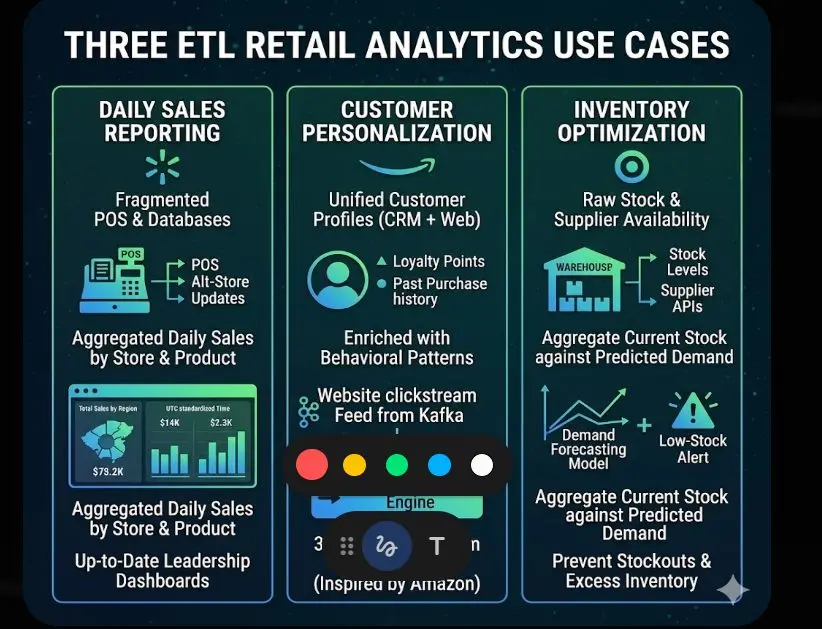
ETL Flow
Extract:
Pull transactions from POS systems, relational DBs, and APIs.
Collect payment gateway logs for online orders.
Transform:
Clean duplicate records caused by multiple system updates.
Convert different currencies into a single base currency.
→ Standardize time zones (e.g., UTC for global comparison).
→ Aggregate KPIs such as daily sales by store, product category, and region.
Load:
- Load into a centralized data warehouse like Snowflake, Redshift, or BigQuery.
- Create dashboards in Tableau or Power BI for leadership.
Business Impact:
- Executives see up-to-date, accurate sales dashboards every morning.
- Regional managers can identify which stores need immediate interventions
(e.g., promotions for underperforming products).
- Finance teams can forecast revenues more accurately with consolidated
data.
Real-World Example:
Walmart uses massive ETL pipelines to process data from 11,000+ stores
worldwide, giving leadership near real-time access to sales data. Their system
processes 2.5 PB/hour, ensuring decisions are made on fresh data.
Customer Personalization:
Modern consumers demand personalized shopping experiences. But customer data
is often siloed: loyalty programs, CRM, website clickstreams, and in-store purchase
history are all stored separately.
- Without integration, retailers send generic promotions that fail to engage
customers.
- This leads to missed opportunities for cross-selling, upselling, and retention
ETL Flow
Extract:
- Pull customer data from CRM (profiles, loyalty points).
- Stream clickstream logs from websites and apps via Kafka.
- Gather past purchase history from transactional databases.
Transform:
- Merge duplicate customer IDs across systems (same customer may appear in
- CRM + app + loyalty program).
- Clean and standardize demographic data (age, location, income group).
- Enrich with behavioral patterns (frequent shopper vs one-time buyer).
- Segment customers into loyal, occasional, at-risk, or new shoppers.
Load:
- Store unified customer profiles in a warehouse.
- Feed data into ML models for product recommendations.
Business Impact:
- Personalized recommendations (“You bought running shoes, here’s a discount
on sports socks”).
- Targeted offers to high-value or at-risk customers.
- Improved email/SMS marketing conversion rates.
- Increased customer retention and lifetime value (CLV).
Real-World Example
- Amazon attributes 35% of its total revenue to its recommendation system,
powered by ETL pipelines that unify browsing + purchase data in near real
time.
Inventory Optimization
Problem
Inventory management is one of retail’s biggest challenges. Stockouts frustrate
customers and cause lost sales, while overstocking ties up capital and increases
warehousing costs.
- With inventory data scattered across warehouses, suppliers, and ERP
systems, retailers lack real-time visibility.
- This leads to inefficient restocking and poor supply chain decisions.
ETL Flow
Extract:
- Pull stock levels from ERP systems and warehouse DBs.
- Fetch supplier availability from external APIs.
Transform:
- Normalize units (e.g., cartons, packs, and singles converted into “units”).
- Aggregate current stock by location and compare against predicted demand.
- Apply business rules (e.g., mark products with <10% buffer stock as “critical”).
Load:
- Store into a warehouse + data lake.
- Power dashboards that show inventory health by product, store, and region.
- Feed into ML models for demand forecasting.
Business Impact
- Prevents lost sales by ensuring popular items are always in stock.
- Reduces warehousing costs by avoiding excess inventory.
- Improves supplier coordination with predictive restocking alerts.
Real-World Example
- Target leverages BigQuery + ETL pipelines to track inventory across 1,900+
stores in real time. Predictive restocking reduces stockouts, improves
operational efficiency, and enhances customer satisfaction.
Summary:
These three use cases show how ETL pipelines transform raw data into business
value:
- Daily Sales Reporting: Unified visibility into revenue.
- Customer Personalization: Smarter, targeted engagement.
- Inventory Optimization: Efficient supply chain management.
More Spark tutorials
- about pyspark
- text diagram
- Apache Spark Runtime Architecture
- Introduction to RDD
- Actions vs Transformations
- Lazy Evaluation in PySpark
All tutorials · Try the free PySpark compiler · Practice challenges