ETL, ELT and ETLT.
Spark tutorial · PySpark.in
ETL, ELT, and ETLT.
It sounds like technical alphabet soup. But getting this architecture wrong will bottleneck your entire data team.
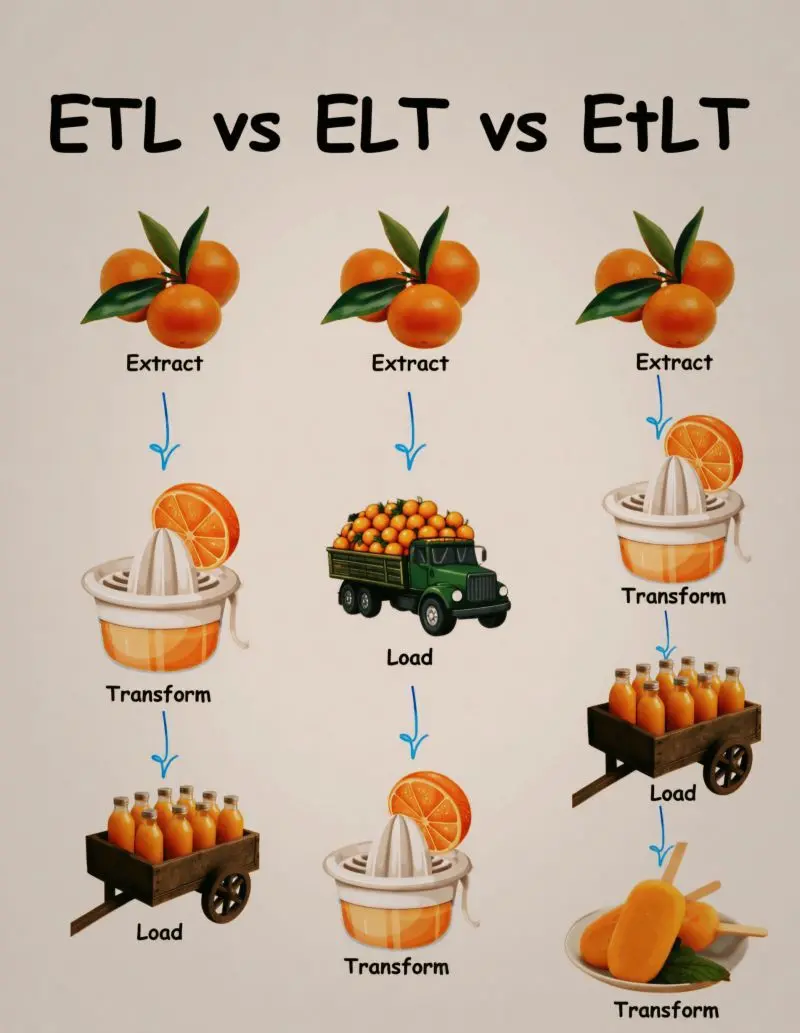
Here is the best visual explanation of data pipelines I’ve ever seen, using nothing but... oranges. 🍊👇
🍊 1. ETL (Extract, Transform, Load)
• EXTRACT: You pick the raw oranges.
• TRANSFORM: You squeeze them into juice using an external juicer.
• LOAD: You ship the bottled juice to its final destination.
THE REALITY: The data is fully transformed BEFORE it hits your warehouse. It's the traditional approach, great for strictly protecting sensitive data before it's stored, but it requires heavy, dedicated processing servers.
🚛 2. ELT (Extract, Load, Transform)
• EXTRACT: You pick the oranges.
• LOAD: You dump the entire truck of raw, whole oranges straight into the warehouse.
• TRANSFORM: You squeeze them on-site using the warehouse's own machinery.
THE REALITY: The modern cloud approach. You load raw data instantly and leverage the massive, cheap compute power of modern cloud data warehouses to transform it later.
🍦 3. ETLT (Extract, "light" transform, Load, "heavy" Transform)
• EXTRACT: You pick the oranges.
• LIGHT TRANSFORM: You squeeze the juice (e.g., standardizing formats or removing PII).
• LOAD: You move the clean juice to the warehouse.
• HEAVY TRANSFORM: You turn that juice into popsicles! (e.g., complex business logic, BI modeling, aggregations).
THE REALITY: The best of both worlds. You secure and clean the data in transit, then use the warehouse's power for the heavy analytical lifting.
Your data architecture isn't just an engineering choice. It's a business choice.
Stop treating your data like a rigid process, and start building pipelines that actually scale with your business.
More Spark tutorials
- about pyspark
- text diagram
- Apache Spark Runtime Architecture
- Introduction to RDD
- Actions vs Transformations
- Lazy Evaluation in PySpark
All tutorials · Try the free PySpark compiler · Practice challenges