Sparse Embeddings in NLP (BM25 & SPLADE)
Nlp tutorial · PySpark.in
Sparse Embeddings are advanced text representation techniques used in Natural Language Processing (NLP) and Information Retrieval (IR). Unlike dense embeddings, sparse embeddings represent text using high-dimensional vectors where most values are zero.
Sparse embeddings are highly effective for:
Search Engines
Information Retrieval
Document Ranking
Semantic Search
Question Answering
Retrieval-Augmented Generation (RAG)
The two most important sparse retrieval methods are:
BM25 (Best Matching 25)
SPLADE (Sparse Lexical and Expansion Model)
These methods are widely used in modern AI retrieval systems and search architectures.
Sparse embeddings are vector representations where:
Most vector elements are zero
Only important terms receive non-zero weights
Example:
Vocabulary:
["AI", "machine", "learning", "football"]
Sentence:
"AI learning"
Sparse vector:
[1,0,1,0]
Only relevant terms are activated.
Why Sparse Embeddings are Important
Sparse retrieval methods are extremely useful because:
They preserve keyword matching
They are interpretable
They work efficiently in search systems
They scale well for large document collections
Modern AI systems often combine:
Dense embeddings
Sparse embeddings
for hybrid retrieval systems.
BM25 (Best Matching 25)
BM25 is one of the most important ranking algorithms used in search engines.
It improves traditional TF-IDF ranking by considering:
Term frequency
Inverse document frequency
Document length normalization
BM25 is widely used in:
Google-like search systems
Elasticsearch
Information retrieval systems
Working Principle of BM25
BM25 ranks documents according to their relevance to a query.
Steps:
Analyze query terms
Calculate term importance
Normalize document length
Compute relevance score
Rank documents
BM25 Formula
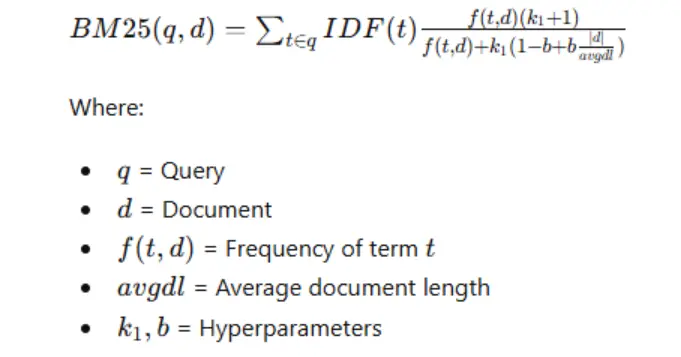
Components of BM25
Component | Purpose |
TF (Term Frequency) | Word occurrence importance |
IDF | Rare word importance |
Length Normalization | Penalizes long documents |
Example of BM25
Query:
"machine learning"
Documents:
Document | Score |
“Machine learning improves AI” | High |
“Football match today” | Low |
Relevant documents receive higher scores.
SPLADE (Sparse Lexical and Expansion Model)
SPLADE is a modern sparse retrieval model that combines:
Sparse embeddings
Transformer architectures
Semantic expansion
Unlike BM25, SPLADE uses neural networks to generate sparse semantic representations.
Main Idea of SPLADE
SPLADE expands queries and documents using transformer-based lexical weighting.
This allows:
Better semantic retrieval
Sparse interpretable vectors
Improved search accuracy
Working Principle of SPLADE
Steps:
Input query/document
Transformer generates token importance
Sparse vectors created
Important terms activated
Retrieval performed using sparse matching
SPLADE Objective
SPLADE uses transformer-based activation functions.
Sparse activation formula:
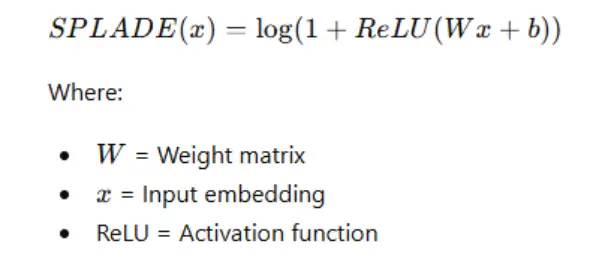
Sparse Retrieval in Modern AI Systems
Modern Retrieval-Augmented Generation (RAG) systems use:
Sparse retrieval
Dense retrieval
Hybrid retrieval
Sparse embeddings improve:
Keyword matching
Explainability
Search efficiency
Hybrid Retrieval Example
Query:
"AI healthcare applications"
BM25 retrieves:
Exact keyword matches
Dense retrieval retrieves:
Semantic matches
Hybrid retrieval combines both.
Practical Implementation Using BM25
Install Libraries
```
Hide
pip install rank-bm25
```
Exmaple:
```
#Import library
from rank_bm25 import BM25Okapi
#Sample documents
documents = [
"machine learning improves ai",
"football is a popular sport",
"deep learning powers modern ai",
"healthcare uses artificial intelligence"
]
#Tokenize documents
tokenized_docs = [
doc.split(" ")
for doc in documents
]
#Create BM25 model
bm25 = BM25Okapi(tokenized_docs)
#Query
query = "machine learning ai".split(" ")
Calculate scores
scores = bm25.get_scores(query)
#Display results
print("BM25 Scores:\n")
print(scores)
```
Practical Implementation Using SPLADE
Install Libraries
```
pip install transformers torch
```
Exmaple:
```
#Import libraries
from transformers import AutoTokenizer, AutoModel import torch
#Load tokenizer and model
tokenizer = AutoTokenizer.from_pretrained(
"distilbert-base-uncased"
)
model = AutoModel.from_pretrained(
"distilbert-base-uncased"
)
Sample text
text = "Artificial Intelligence improves healthcare"
#Tokenize input
inputs = tokenizer(
text,
return_tensors="pt"
)
#Generate embeddings
outputs = model(**inputs)
#Last hidden states
embeddings = outputs.last_hidden_state
#Print shape
print("Embedding Shape:\n")
print(embeddings.shape)
```
Sparse Retrieval in RAG Systems
Retrieval-Augmented Generation systems retrieve relevant documents before generating responses.
Sparse retrieval improves:
Accuracy
Explainability
Retrieval precision
This is widely used in:
ChatGPT-style systems
Enterprise AI search
AI assistants
Conclusion
Sparse embeddings are highly important for modern information retrieval and semantic search systems. Techniques such as BM25 provide efficient lexical ranking using statistical relevance scoring, while advanced neural sparse models such as SPLADE combine transformer-based semantic understanding with sparse retrieval efficiency. These methods play a crucial role in search engines, enterprise retrieval systems, Retrieval-Augmented Generation (RAG), and modern AI-powered information access systems.
More Nlp tutorials
- Natural Language Understanding (NLU) , Natural Language Generation (NLG) and phases of NL
- Tokenization in NLP and NLP Project Life Cycle
- Coverting The Text to Vector(one hot encoding and bag of words method)
- Convert text to vector: N-grams and TF-IDF method
- Word Embedding
- What is Natural Language Processing ?
All tutorials · Try the free PySpark compiler · Practice challenges