Sentence Embeddings in NLP (SBERT & USE)
Nlp tutorial · PySpark.in
Sentence Embeddings are advanced text representation techniques in Natural Language Processing (NLP) used to convert entire sentences, paragraphs, or documents into dense numerical vectors. Unlike word embeddings that represent individual words, sentence embeddings capture the semantic meaning of complete sentences.
Sentence embeddings are widely used in:
Semantic Search
Question Answering
Recommendation Systems
Text Similarity
Chatbots
Information Retrieval
Conversational AI
The two most popular sentence embedding models are:
SBERT (Sentence-BERT)
USE (Universal Sentence Encoder)
These models significantly improved semantic understanding in NLP systems.
What are Sentence Embeddings?
Sentence embeddings are dense vector representations of complete sentences.
Example:
Sentence 1:
"I love Natural Language Processing"
Sentence 2:
"NLP is my favorite subject"
Although the sentences use different words, they have similar meanings.
Sentence embedding models generate vectors that place semantically similar sentences close together in vector space.
SBERT (Sentence-BERT)
SBERT was developed to improve sentence similarity tasks using BERT.
Traditional BERT is computationally expensive for sentence comparison because each pair of sentences must be processed together.
SBERT solves this by generating fixed-size sentence embeddings independently.
Architecture of SBERT
SBERT uses:
BERT Encoder
Pooling Layer
Sentence Embedding Vector
Working Principle of SBERT
Steps:
Input sentence is tokenized
BERT generates contextual embeddings
Pooling layer combines token embeddings
Final sentence embedding is generated
Example
Sentence:
"Artificial Intelligence is transforming healthcare"
Output vector:
[0.24, 0.67, 0.91, ...]
Pooling in SBERT
Pooling converts token embeddings into a single sentence vector.
Common pooling methods:
Pooling Type | Description |
Mean Pooling | Average embeddings |
Max Pooling | Maximum value selection |
CLS Pooling | Uses [CLS] token |
SBERT Objective
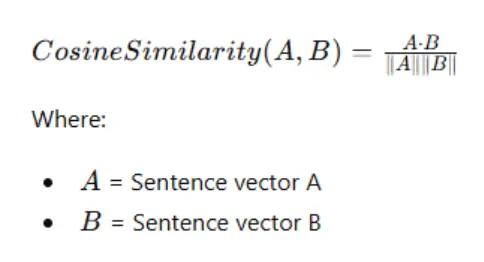
SBERT uses cosine similarity for semantic comparison.
Formula
Universal Sentence Encoder (USE)
USE (Universal Sentence Encoder) was developed by Google.
It generates embeddings for:
Sentences
Paragraphs
Documents
USE is optimized for semantic similarity and transfer learning tasks.
Deep Averaging Network (DAN)
DAN averages word embeddings and passes them through dense neural layers.
It is:
Faster
Lightweight
Efficient for production systems
Working Principle of USE
Steps:
Tokenize sentence
Generate embeddings
Encode semantic meaning
Produce fixed-size vector
Example
Sentence:
"Machine Learning is powerful"
Embedding:
[0.12, 0.89, 0.56, ...]
Sentence Similarity
Sentence embeddings are commonly used for similarity comparison.
Example:
Sentence 1:
"I love AI"
Sentence 2:
"I enjoy Artificial Intelligence"
These sentences receive high cosine similarity scores.
Similarity Formula
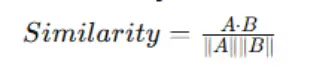
Higher similarity indicates closer semantic meaning.
Practical Implementation Using SBERT
Install Libraries
```
Hide
pip install sentence-transformers
```
Example:
```
Import library
from sentence_transformers import SentenceTransformer from sklearn.metrics.pairwise import cosine_similarity
Load SBERT model
model = SentenceTransformer('all-MiniLM-L6-v2')
Sample sentences
sentences = [
"I love Natural Language Processing",
"NLP is very interesting",
"Football is a popular sport"
]
Generate embeddings
embeddings = model.encode(sentences)
Print embedding shape
print("Embedding Shape:\n")
print(embeddings.shape)
Calculate similarity
similarity = cosine_similarity([embeddings[0]], [embeddings[1]])
print("\nSimilarity Score:\n")
print(similarity)
```
Practical Implementation Using USE
Install Libraries
```
pip install tensorflow tensorflow-hub
```
Example:
```
Import libraries
import tensorflow_hub as hub from sklearn.metrics.pairwise import cosine_similarity
Load USE model
model = hub.load(
)
Sample sentences
sentences = [
"Artificial Intelligence is powerful",
"AI is transforming industries"
]
Generate embeddings
embeddings = model(sentences)
Similarity calculation
similarity = cosine_similarity(
[embeddings[0]],
[embeddings[1]]
)
print("Similarity Score:\n")
print(similarity)
```
Conclusion
Sentence embeddings represent one of the most important advancements in semantic representation for Natural Language Processing. Models such as SBERT and USE generate dense contextual vectors capable of capturing the semantic meaning of complete sentences. SBERT provides highly accurate semantic similarity using transformer-based architectures, while USE offers efficient and scalable sentence encoding solutions. These models play a critical role in modern AI systems including semantic search engines, conversational agents, recommendation systems, and intelligent information retrieval applications.
More Nlp tutorials
- Natural Language Understanding (NLU) , Natural Language Generation (NLG) and phases of NL
- Tokenization in NLP and NLP Project Life Cycle
- Coverting The Text to Vector(one hot encoding and bag of words method)
- Convert text to vector: N-grams and TF-IDF method
- Word Embedding
- What is Natural Language Processing ?
All tutorials · Try the free PySpark compiler · Practice challenges