Contextual Embeddings in NLP (ELMo, BERT, GPT)
Nlp tutorial · PySpark.in
Contextual Embeddings are one of the most advanced and important developments in Natural Language Processing (NLP). Unlike traditional embedding techniques such as Word2Vec, GloVe, and FastText, contextual embeddings generate different vector representations for the same word depending on its context in a sentence.
This advancement significantly improved machine understanding of language semantics, ambiguity, and context.
Contextual embedding models are widely used in:
Chatbots
Question Answering Systems
Machine Translation
Text Summarization
Search Engines
Conversational AI
Large Language Models (LLMs)
The most important contextual embedding models are:
ELMo
BERT
GPT
These models transformed modern NLP and became the foundation of Generative AI systems.
Need for Contextual Embeddings
Traditional embeddings generate only one vector per word.
Example:
"I deposited money in the bank"
"The river bank is beautiful"
The word:
"bank"
has two different meanings.
However:
Word2Vec generates the same vector for both.
GloVe generates the same vector for both.
This creates ambiguity.
Contextual embeddings solve this problem by generating context-dependent vectors.
What are Contextual Embeddings?
Contextual embeddings generate dynamic vectors based on sentence context.
Example:
Sentence | Meaning of “bank” |
I deposited money in the bank | Financial institution |
River bank is beautiful | Side of river |
Contextual models assign different embeddings for each usage.
Evolution of Word Embeddings
Model | Type | Context Awareness |
Bag of Words | Sparse | No |
Word2Vec | Static Embedding | No |
GloVe | Static Embedding | No |
FastText | Subword Embedding | Partial |
ELMo | Contextual Embedding | Yes |
BERT | Deep Bidirectional Contextual | Yes |
GPT | Generative Contextual Model | Yes |
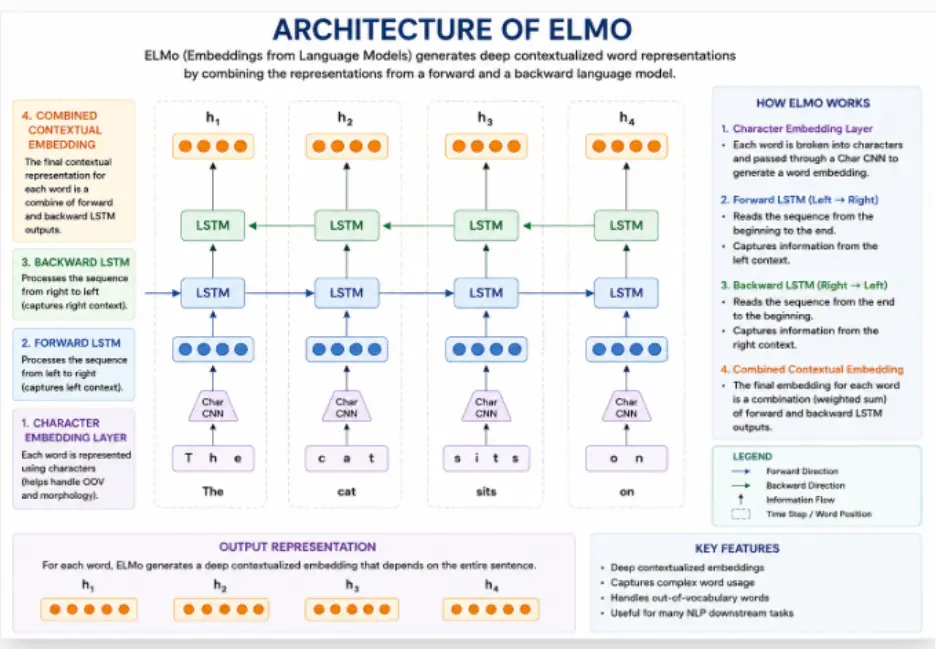
ELMo (Embeddings from Language Models)
ELMo was developed by AllenNLP in 2018.
It introduced the idea of:
Contextual word embeddings using deep bidirectional language models.
ELMo uses:
Bi-directional LSTMs
Character-level embeddings
Dynamic context learning
GPT (Generative Pre-trained Transformer)
GPT was developed by OpenAI.
GPT is a:
Decoder-only transformer model designed for text generation.
Unlike BERT:
BERT is bidirectional
GPT is autoregressive
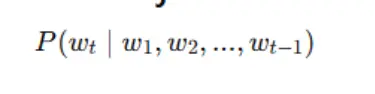
GPT predicts the next word sequentially.
Example of GPT
Input:
"Artificial Intelligence is"
Prediction:
"transforming the world"
GPT Objective Function
Architecture of GPT
GPT consists of:
Token Embeddings
Positional Encoding
Transformer Decoder Blocks
Self-Attention Layers
Output Prediction Layer
Limitations of GPT
Limitation | Explanation |
Expensive training | Massive computation |
Hallucination issues | Incorrect generation |
Requires huge datasets | Data-intensive training |
Practical Implementation Using BERT
Install Libraries
```
pip install transformers torch
```
Example:
```
Import libraries
from transformers import BertTokenizer, BertModel import torch
Load pretrained BERT tokenizer and model
tokenizer = BertTokenizer.from_pretrained('bert-base-uncased')
model = BertModel.from_pretrained('bert-base-uncased')
Sample text
text = "Natural Language Processing is amazing"
Tokenize input
inputs = tokenizer(text, return_tensors='pt')
Generate embeddings
outputs = model(**inputs)
Last hidden states
embeddings = outputs.last_hidden_state
Print embedding shape
print("Embedding Shape:\n")
print(embeddings.shape)
```
Explanation:
1 → Batch size
7 → Number of tokens
768 → Embedding dimension
Implementation Using GPT
```
Import pipeline
from transformers import pipeline
Create text generator
generator = pipeline(
'text-generation',
model='gpt2'
)
Generate text
output = generator(
"Artificial Intelligence is",
max_length=30,
num_return_sequences=1
)
Print generated text
print(output[0]['generated_text'])
```
Conclusion
Contextual embeddings represent one of the most transformative advancements in Natural Language Processing. Models such as ELMo, BERT, and GPT introduced dynamic context-aware word representations that significantly improved machine understanding of language. ELMo pioneered bidirectional contextual embeddings using LSTMs, BERT revolutionized NLP using transformer encoders and bidirectional attention, and GPT enabled highly advanced generative language modeling. These models form the foundation of modern AI systems, including chatbots, search engines, virtual assistants, and large language models.
More Nlp tutorials
- Natural Language Understanding (NLU) , Natural Language Generation (NLG) and phases of NL
- Tokenization in NLP and NLP Project Life Cycle
- Coverting The Text to Vector(one hot encoding and bag of words method)
- Convert text to vector: N-grams and TF-IDF method
- Word Embedding
- What is Natural Language Processing ?
All tutorials · Try the free PySpark compiler · Practice challenges