GloVe and FastText in NLP
Nlp tutorial · PySpark.in
GloVe and FastText in NLP
GloVe (Global Vectors) and FastText are advanced word embedding techniques used in Natural Language Processing (NLP) for generating dense vector representations of words. These models improve semantic understanding compared to traditional techniques such as Bag of Words and TF-IDF.
Both GloVe and FastText are extensions of distributed word representation methods and are widely used in:
Semantic Search
Chatbots
Recommendation Systems
Machine Translation
Sentiment Analysis
Question Answering Systems
Although both techniques generate dense embeddings, they differ in their learning approaches and handling of vocabulary
GloVe (Global Vectors for Word Representation) is a word embedding model developed by Stanford University.
GloVe combines:
Global statistical information
Local contextual learning
Unlike Word2Vec, which learns embeddings from local context windows, GloVe uses a global word co-occurrence matrix to learn relationships between words.
Co-occurrence?
Co-occurrence refers to how frequently two words appear together in a corpus.
Example sentence:
"The cat sits on the mat"
Co-occurrence examples:
Word Pair | Frequency |
cat – sits | High |
cat – mat | Medium |
cat – airplane | Very Low |
GloVe learns semantic relationships from these co-occurrence statistics.
Working Principle of GloVe
The main idea behind GloVe is: Words that occur in similar contexts should have similar vector representations.
Steps involved:
Build co-occurrence matrix
Calculate statistical relationships
Train embeddings using matrix factorization
Generate dense word vectors
Example Co-occurrence Matrix
Word | cat | dog | milk |
cat | 0 | 5 | 3 |
dog | 5 | 0 | 1 |
milk | 3 | 1 | 0 |
This matrix helps GloVe understand semantic relationships.
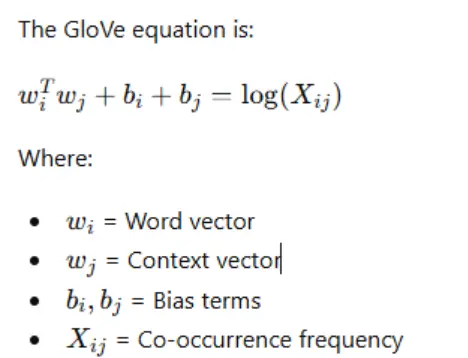
GloVe Objective Function
The GloVe equation is: The model minimizes differences between predicted and actual co-occurrence probabilities.
Example Limitation
Sentence 1:
"I deposited money in the bank"
Sentence 2:
"The river bank is beautiful"
GloVe generates the same embedding for “bank” in both sentences.
FastText
FastText is a word embedding model developed by Facebook AI Research.
Unlike Word2Vec and GloVe, FastText represents words using:
Character n-grams
Subword information
This enables FastText to handle:
Rare words
Misspellings
Morphologically rich languages
Unknown words
Working Principle of FastText
FastText breaks words into smaller character-level units called n-grams.
Example:
Word:
"playing"
Character n-grams:
["pla", "lay", "ayi", "yin", "ing"]
The final word embedding is obtained by combining subword embeddings.
Why FastText is Important
Traditional embeddings fail for unknown words.
Example:
"computerization"
Even if the exact word is unseen, FastText can infer meaning using subwords:
["comp", "puter", "ization"]
Thus, FastText reduces the Out-of-Vocabulary (OOV) problem.
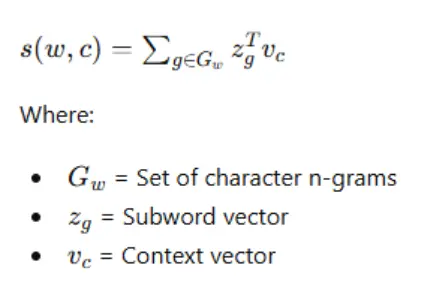
FastText Objective Function
FastText extends Word2Vec using subword vectors.
The prediction function is:
Practical Implementation Using GloVe
Install Libraries
```
Hide
pip install gensim
```
GloVe Embeddings
```
#Import libraries
from sklearn.feature_extraction.text import TfidfVectorizer from sklearn.metrics.pairwise import cosine_similarity
#Sample documents
documents = [
"king queen prince royal",
"man woman boy girl",
"apple banana mango fruit",
"car bus train vehicle"
]
#Create TF-IDF Vectorizer
vectorizer = TfidfVectorizer()
#Convert text into vectors
X = vectorizer.fit_transform(documents)
#Display vocabulary
print("Vocabulary:\n")
print(vectorizer.get_feature_names_out())
#Convert sparse matrix to array
vectors = X.toarray()
#Display vectors
print("\nTF-IDF Vectors:\n")
print(vectors)
#Calculate cosine similarity
similarity = cosine_similarity(vectors)
#Display similarity matrix
print("\nCosine Similarity Matrix:\n")
print(similarity)
```
Implementation of FastText
```
#Import library
from gensim.models import FastText
#Sample sentences
sentences = [
["i", "love", "nlp"],
["machine", "learning", "is", "powerful"],
["deep", "learning", "improves", "ai"],
["nlp", "uses", "machine", "learning"]
]
#Train FastText model
model = FastText(
sentences,
vector_size=100,
window=5,
min_count=1,
workers=4
)
#Display vector
print("Word Vector for 'learning':\n")
print(model.wv['learning'])
#Similar words
print("\nMost Similar Words:\n")
print(model.wv.most_similar('learning'))
```
Conclusion
GloVe and FastText are highly influential word embedding techniques in Natural Language Processing. GloVe captures semantic relationships using global co-occurrence statistics, whereas FastText improves word representation using character-level subword information. Both methods provide dense semantic embeddings that significantly improve NLP tasks such as text classification, search systems, recommendation engines, and semantic analysis. Although modern contextual embeddings such as BERT and GPT provide superior performance, GloVe and FastText remain foundational techniques for understanding word embedding methodologies in NLP.
More Nlp tutorials
- Natural Language Understanding (NLU) , Natural Language Generation (NLG) and phases of NL
- Tokenization in NLP and NLP Project Life Cycle
- Coverting The Text to Vector(one hot encoding and bag of words method)
- Convert text to vector: N-grams and TF-IDF method
- Word Embedding
- What is Natural Language Processing ?
All tutorials · Try the free PySpark compiler · Practice challenges