Word2Vec in NLP
Nlp tutorial · PySpark.in
Word2Vec is one of the most important and revolutionary word embedding techniques in Natural Language Processing (NLP). It was introduced by Google in 2013 and is used to convert words into dense numerical vectors that capture semantic and syntactic relationships between words.
Unlike traditional text representation methods such as Bag of Words (BoW) and TF-IDF, Word2Vec learns the meaning of words based on their surrounding context.
Word2Vec is widely used in:
Semantic Analysis
Text Classification
Chatbots
Recommendation Systems
Machine Translation
Search Engines
Word2Vec is a shallow neural network-based embedding model that transforms words into dense vector representations.The main objective of Word2Vec is:Words with similar meanings should have similar vector representations.
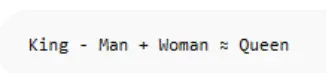
For example: This demonstrates that Word2Vec captures semantic relationships between words.
Why Word2Vec is Important
Traditional methods such as BoW generate sparse vectors and cannot understand semantic meaning.
Example:
Word | Meaning |
King | Royal male |
Queen | Royal female |
BoW treats them as unrelated words.
Word2Vec learns their semantic relationship using vector space representations.
Working Principle of Word2Vec
Word2Vec learns embeddings by analyzing neighboring words in sentences.
The main idea:
Context defines meaning.
Example sentence:
"The cat sits on the mat"
Context words around “sits” help the model understand its meaning.
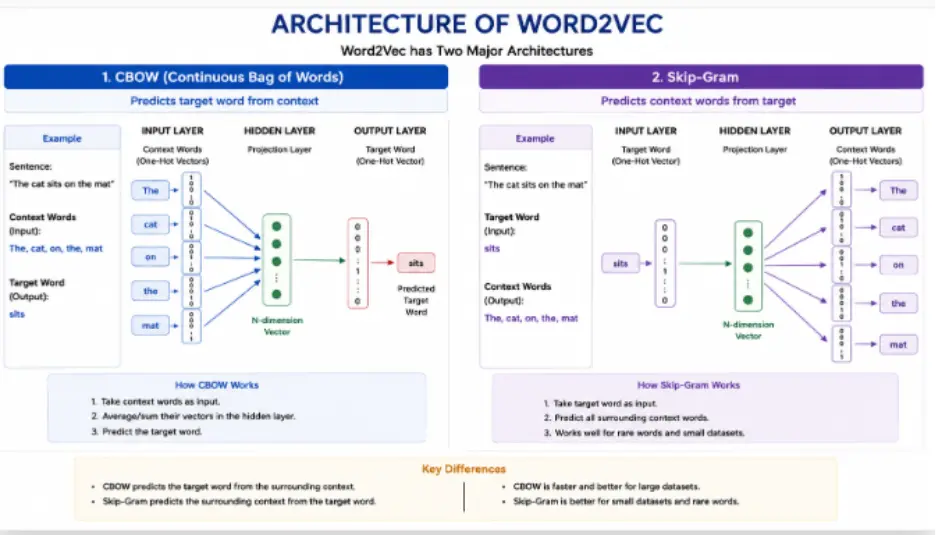
CBOW (Continuous Bag of Words)
CBOW predicts the missing target word using surrounding context words.
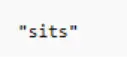
Example of CBOW
Sentence:
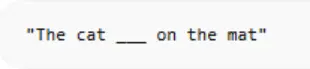
Input context:

Prediction:
CBOW is generally:
Faster
Better for large datasets
Efficient for frequent words
CBOW Objective Function
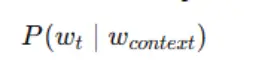
Skip-Gram Model
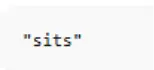
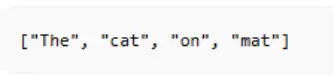
Skip-Gram works opposite to CBOW. It predicts surrounding context words using the target word.
Example of Skip-Gram
Input word:
Predicted context:
Skip-Gram is generally:
Better for small datasets
Good for rare words
More accurate than CBOW
Skip-Gram Objective Function
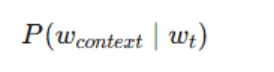
Neural Network Structure of Word2Vec
Word2Vec uses a shallow neural network with:
Input Layer
Hidden Layer
Output Layer
The hidden layer weights become the final word embeddings.
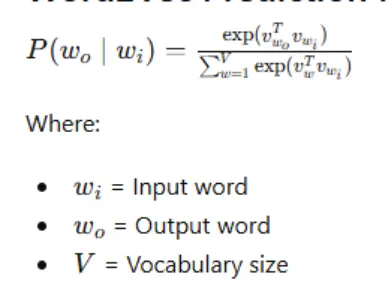
Word2Vec Prediction Formula
One-Hot Encoding Problem
Before Word2Vec, words were represented using one-hot vectors.
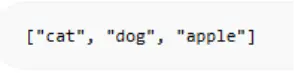
Example vocabulary:
One-hot vectors:
Word | Vector |
cat | [1,0,0] |
dog | [0,1,0] |
apple | [0,0,1] |
Problems:
Sparse vectors
No semantic meaning
High dimensionality
Word2Vec solves these issues using dense embeddings.
Dense Vector Representation
Word2Vec generates dense low-dimensional vectors.
Example:
Word | Vector |
king | [0.24, 0.67, 0.81] |
queen | [0.22, 0.71, 0.79] |
Similar words have similar vectors.
Semantic Relationships in Word2Vec
Word2Vec captures semantic relationships mathematically.
Example: This is called vector arithmetic.

Example Problem
Sentence 1:
"I went to the bank"
Sentence 2:
"The river bank is beautiful"
Word2Vec generates the same vector for “bank” in both sentences.
Practical Implementation Using Python
Problem Statement
Train a Word2Vec model on sample sentences and generate word embeddings.
Install Libraries
```
Hide
pip install gensim
```
Example:
```
#Import library
from gensim.models import Word2Vec
#Sample sentences
sentences = [
["i", "love", "nlp"],
["machine", "learning", "is", "powerful"],
["deep", "learning", "improves", "ai"],
["nlp", "uses", "machine", "learning"],
["artificial", "intelligence", "is", "future"]
]
#Train Word2Vec model
model = Word2Vec(
sentences,
vector_size=100,
window=5,
min_count=1,
workers=4
)
#Display vocabulary
print("Vocabulary:\n")
print(model.wv.index_to_key)
#Display vector for a word
print("\nWord Vector for 'learning':\n")
print(model.wv['learning'])
#Find similar words
print("\nMost Similar Words to 'learning':\n")
print(model.wv.most_similar('learning'))
```
Finding Similar Words
Word2Vec can identify semantically similar words.
Example:
```
Hide
print(model.wv.most_similar('machine'))
```
Cosine Similarity in Word2Vec
Similarity between words is measured using cosine similarity.
Formula:

Higher cosine similarity means words are more semantically related.
Conclusion
Word2Vec is one of the foundational embedding techniques in Natural Language Processing that revolutionized text representation by introducing dense semantic word embeddings. Unlike traditional sparse representations, Word2Vec captures relationships between words using neural network-based learning approaches such as CBOW and Skip-Gram. Although modern contextual embedding models such as BERT and GPT have surpassed Word2Vec in performance, Word2Vec remains an essential concept for understanding semantic embeddings and the evolution of modern NLP systems.
More Nlp tutorials
- Natural Language Understanding (NLU) , Natural Language Generation (NLG) and phases of NL
- Tokenization in NLP and NLP Project Life Cycle
- Coverting The Text to Vector(one hot encoding and bag of words method)
- Convert text to vector: N-grams and TF-IDF method
- Word Embedding
- What is Natural Language Processing ?
All tutorials · Try the free PySpark compiler · Practice challenges