Bag of Words (BoW) in NLP
Nlp tutorial · PySpark.in
Bag of Words (BoW) is one of the simplest and most fundamental text representation techniques used in Natural Language Processing (NLP). It converts textual data into numerical vectors so that machine learning algorithms can process and analyze the text.
The Bag of Words model represents a document based on the frequency of words present in it, without considering grammar, sentence structure, or word order.
It is widely used in:
Text Classification
Spam Detection
Sentiment Analysis
Document Categorization
Information Retrieval
The Bag of Words model treats a document as a collection (“bag”) of words.
It focuses only on:
Whether a word appears
How many times the word appears
It ignores:
Word order
Grammar
Context
Semantics
Example
Sentence 1:
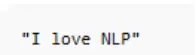
Sentence 2:
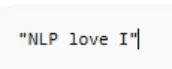
Bag of Words treats both sentences as identical because the same words are present.
Working Principle of Bag of Words
The Bag of Words model works in the following stages.
Step 1: Text Collection
Example documents:
Document 1: "I love NLP"
Document 2: "I love Machine Learning"
Step 2: Text Preprocessing
Common preprocessing operations include:
Lowercasing
Removing punctuation
Tokenization
Stop-word removal
Example:
Before preprocessing:
"I LOVE NLP!!!"
After preprocessing:
["love", "nlp"]
Step 3: Build Vocabulary
Vocabulary contains all unique words from the dataset.
Vocabulary:
["i", "love", "nlp", "machine", "learning"]
Step 4: Convert Text into Vectors
Each document is represented as a frequency vector.
Document | i | love | nlp | machine | learning |
D1 | 1 | 1 | 1 | 0 | 0 |
D2 | 1 | 1 | 0 | 1 | 1 |
This matrix is called the Document-Term Matrix (DTM).
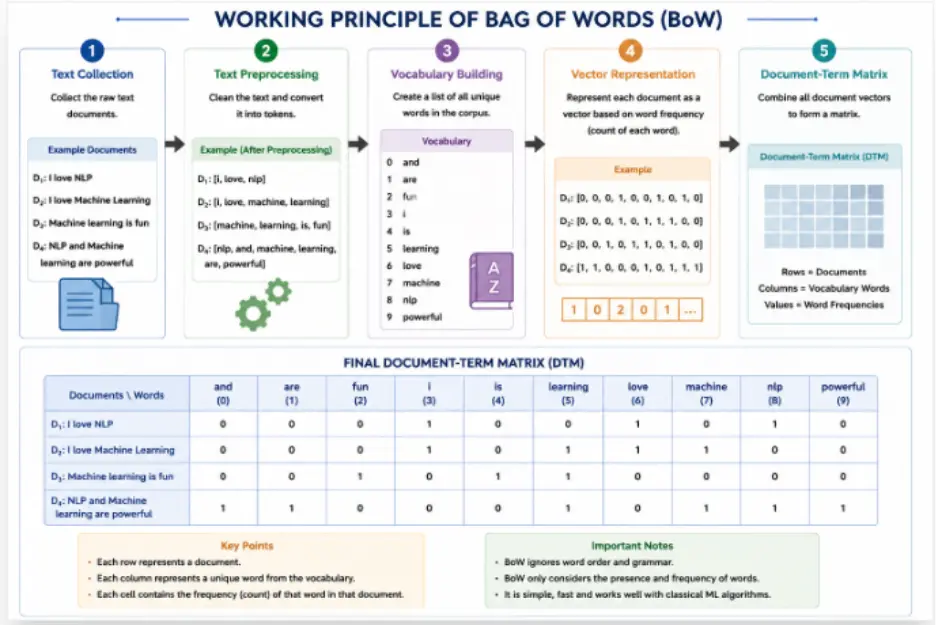
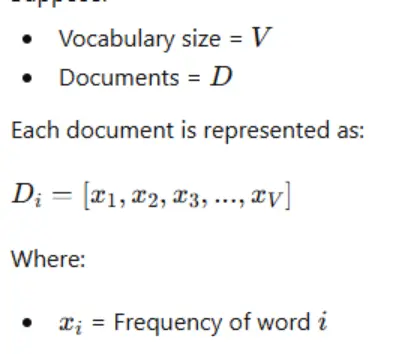
2.3.3 Mathematical Representation of BoW
Suppose:
Example Vector
Sentence:
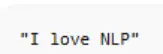
Vector:
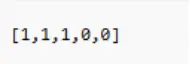
Types of Bag of Words
1. Binary Bag of Words
Represents only presence or absence.
Example:
Word | Value |
love | 1 |
machine | 0 |
2. Frequency Bag of Words
Represents word count frequencies.
Example:
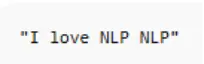
Vector:
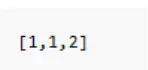
Applications of Bag of Words
Application | Example |
Spam Detection | Email classification |
Sentiment Analysis | Positive/negative reviews |
Document Classification | Topic categorization |
Search Engines | Keyword matching |
Chatbots | Intent detection |
CountVectorizer in Scikit-Learn
In Python, Bag of Words is commonly implemented using:
```
Hide
CountVectorizer
```
from Scikit-learn.
CountVectorizer automatically:
Tokenizes text
Builds vocabulary
Converts text into vectors
Practical Implementation Using Python
Problem Statement
Convert text documents into Bag of Words vectors.
```
#Import library
from sklearn.feature_extraction.text import CountVectorizer
#Sample documents
documents = [
"I love NLP",
"NLP is very interesting",
"I love machine learning",
"Machine learning and NLP are powerful"
]
#Create CountVectorizer object
vectorizer = CountVectorizer()
#Convert text into Bag of Words vectors
X = vectorizer.fit_transform(documents)
#Print vocabulary
print("Vocabulary:\n")
print(vectorizer.get_feature_names_out())
#Print vector representation
print("\nBag of Words Matrix:\n")
print(X.toarray())
```
Binary Bag of Words Example
```
from sklearn.feature_extraction.text import CountVectorizer
documents = [
"I love NLP",
"NLP is amazing"
]
# Binary vectorization
vectorizer = CountVectorizer(binary=True)
X = vectorizer.fit_transform(documents)
print(vectorizer.get_feature_names_out())
print(X.toarray())
```
Conclusion
Bag of Words is one of the most fundamental and widely used text representation techniques in Natural Language Processing. It converts textual documents into numerical vectors based on word frequency and forms the basis for many classical machine learning algorithms. Although it ignores semantic meaning and contextual relationships, Bag of Words remains an important introductory technique due to its simplicity, speed, and effectiveness in basic NLP tasks.
More Nlp tutorials
- Natural Language Understanding (NLU) , Natural Language Generation (NLG) and phases of NL
- Tokenization in NLP and NLP Project Life Cycle
- Coverting The Text to Vector(one hot encoding and bag of words method)
- Convert text to vector: N-grams and TF-IDF method
- Word Embedding
- What is Natural Language Processing ?
All tutorials · Try the free PySpark compiler · Practice challenges