Logistic Regression for Text Classification in NLP
Nlp tutorial · PySpark.in
Logistic Regression for Text Classification in NLP
Logistic Regression is one of the most fundamental supervised machine learning algorithms used for classification tasks. In Natural Language Processing (NLP), Logistic Regression is widely applied for text classification problems such as spam detection, sentiment analysis, fake news detection, email classification, and document categorization.
Despite its name, Logistic Regression is primarily a classification algorithm rather than a regression algorithm. It predicts the probability that a given text belongs to a particular class.
Because of its simplicity, speed, and effectiveness, Logistic Regression is considered one of the strongest baseline models for NLP tasks.
Introduction to Logistic Regression
Logistic Regression is a probabilistic classification algorithm that predicts the probability of a data point belonging to a specific category.
For example:
Text | Label |
“I love this movie” | Positive |
“Worst product ever” | Negative |
The model learns patterns from textual features and predicts whether the sentiment is positive or negative.
Why Logistic Regression is Important in NLP
Text classification datasets usually contain:
High-dimensional data
Sparse vectors
Large vocabularies
Logistic Regression performs efficiently in such environments because:
It handles sparse text vectors effectively.
It trains quickly.
It provides probabilistic outputs.
It works well with TF-IDF features.
It serves as an excellent baseline classifier.
Sigmoid Function
Logistic Regression uses the Sigmoid (Logistic) Function to convert outputs into probabilities between 0 and 1.
The sigmoid equation is:
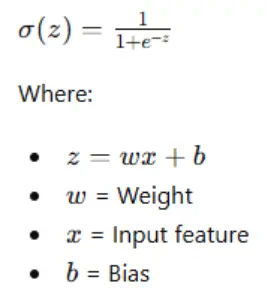
The output probability lies between 0 and 1.
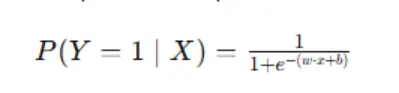
Logistic Regression Prediction Function
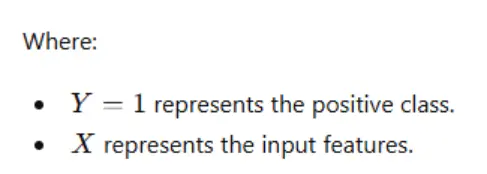
The prediction equation is:
Decision Boundary
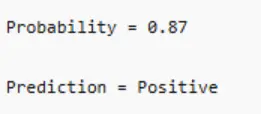
Logistic Regression classifies data based on probability thresholds.
Probability | Prediction |
≥ 0.5 | Positive Class |
< 0.5 | Negative Class |
Example:
Workflow of Logistic Regression in NLP
Step 1: Collect Text Data
Example dataset:
Text | Label |
“Amazing movie” | Positive |
“Worst experience” | Negative |
“Excellent product” | Positive |
“Very bad service” | Negative |
Step 2: Text Preprocessing
Text preprocessing improves text quality before training.
Common preprocessing steps include:
Lowercasing
Removing punctuation
Tokenization
Stop-word removal
Stemming/Lemmatization
Example:
Before preprocessing:

After preprocessing:
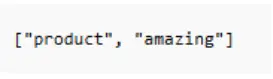
Step 3: Feature Extraction
Machine learning algorithms require numerical inputs.
Text is converted into vectors using:
Bag of Words (BoW)
TF-IDF
TF-IDF is commonly preferred with Logistic Regression.
Example vocabulary:

Sentence:
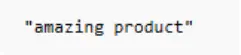
Vector representation:
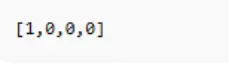
Step 4: Train Logistic Regression Model
The model learns weights for each feature during training.
Prediction score:
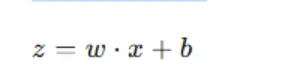
Probability:
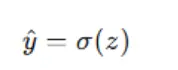
The sigmoid function converts the score into a probability.
Step 5: Prediction
Example input:
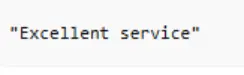
Output:
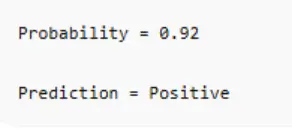
Cost Function in Logistic Regression
Logistic Regression uses Log Loss (Cross-Entropy Loss).
The formula is:

The objective is to minimize prediction error.
Gradient Descent
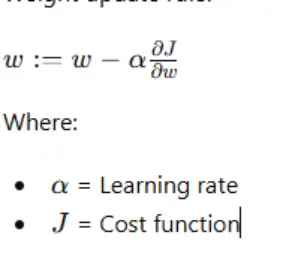
Gradient Descent is used to optimize model parameters.
Weight update rule:
Practical Implementation
Problem Statement
Build a sentiment analysis classifier using Logistic Regression.
```
#Import libraries
import pandas as pd
from sklearn.feature_extraction.text import TfidfVectorizer
from sklearn.model_selection import train_test_split
from sklearn.linear_model import LogisticRegression
from sklearn.metrics import accuracy_score, classification_report
#Dataset
data = {
"text": [
"I love this product",
"Amazing customer service",
"Worst experience ever",
"Very disappointing",
"Excellent quality",
"I hate this item"
],
"label": [
"positive",
"positive",
"negative",
"negative",
"positive",
"negative"
]
}
#Create DataFrame
df = pd.DataFrame(data)
#Features and target
X = df["text"]
y = df["label"]
#TF-IDF Vectorization
vectorizer = TfidfVectorizer()
X_vectorized = vectorizer.fit_transform(X)
#Split dataset
X_train, X_test, y_train, y_test = train_test_split(
X_vectorized,
y,
test_size=0.3,
random_state=42
)
#Create Logistic Regression model
model = LogisticRegression()
#Train model
model.fit(X_train, y_train)
#Prediction
y_pred = model.predict(X_test)
#Accuracy
print("Accuracy:", accuracy_score(y_test, y_pred))
#Classification Report
print(classification_report(y_test, y_pred))
#Test custom sentence
message = ["excellent product"]
message_vector = vectorizer.transform(message)
prediction = model.predict(message_vector)
print("Prediction:", prediction[0])
```
Conclusion
Logistic Regression is one of the most important and effective baseline models for Natural Language Processing tasks. Its ability to efficiently handle sparse high-dimensional text data makes it highly suitable for sentiment analysis, spam detection, and document classification. Although modern deep learning methods provide higher performance for complex NLP tasks, Logistic Regression remains a widely used and reliable classical machine learning algorithm due to its simplicity, interpretability, and computational efficiency.
More Nlp tutorials
- Natural Language Understanding (NLU) , Natural Language Generation (NLG) and phases of NL
- Tokenization in NLP and NLP Project Life Cycle
- Coverting The Text to Vector(one hot encoding and bag of words method)
- Convert text to vector: N-grams and TF-IDF method
- Word Embedding
- What is Natural Language Processing ?
All tutorials · Try the free PySpark compiler · Practice challenges