Decision Trees for NLP
Nlp tutorial · PySpark.in
Decision Trees for NLP
Decision Tree is a supervised machine learning algorithm used for both classification and regression tasks. In Natural Language Processing (NLP), Decision Trees are primarily used for text classification tasks such as spam detection, sentiment analysis, document categorization, and topic classification.
A Decision Tree works by splitting the dataset into branches based on feature conditions and making predictions through a tree-like structure.
The model resembles a flowchart where:
Internal nodes represent conditions/features
Branches represent decision rules
Leaf nodes represent output classes
Decision Trees are simple, interpretable, and easy to visualize, making them useful for understanding classification logic. A Decision Tree is a hierarchical structure used for decision-making and classification. The algorithm repeatedly splits the data based on the most informative features until the final prediction is obtained.
For example:
Text | Class |
“Win free money” | Spam |
“Project meeting tomorrow” | Ham |
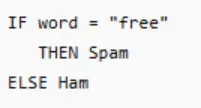
The Decision Tree learns rules such as:
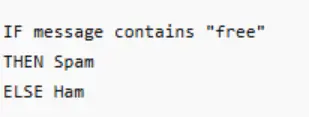
Working Principle of Decision Tree
The Decision Tree algorithm works by recursively splitting the dataset into smaller subsets based on the best feature.
The objective is to maximize class purity after every split.
The splitting process continues until:
All samples belong to the same class
Maximum depth is reached
No further splitting is possible
Important Concepts in Decision Trees
1. Entropy
Entropy measures impurity or randomness in the dataset.
The entropy formula is:

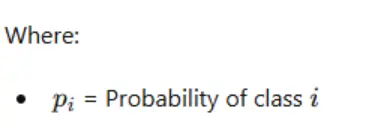
Interpretation
Entropy Value | Meaning |
0 | Pure dataset |
1 | Highly impure dataset |
2. Information Gain
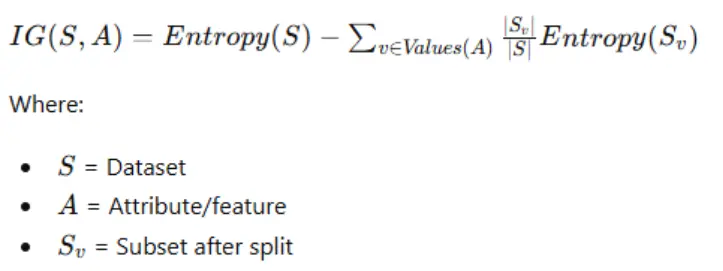
Information Gain measures how much entropy decreases after splitting.
The formula is: The feature with the highest Information Gain is selected for splitting.
3. Gini Index
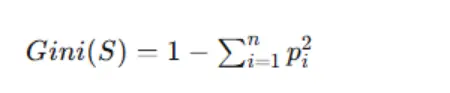
Another splitting criterion used in Decision Trees.
The formula is: Lower Gini value indicates better purity.
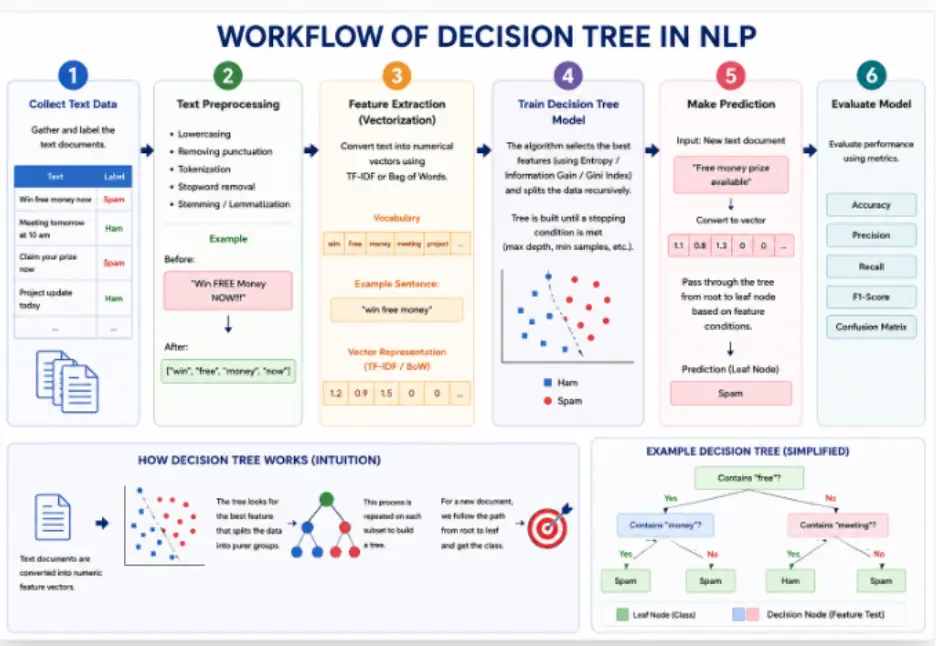
Workflow of Decision Tree in NLP
Step 1: Collect Text Data
Example dataset:
Text | Label |
“Win lottery now” | Spam |
“Meeting tomorrow” | Ham |
“Free prize available” | Spam |
“Project update today” | Ham |
Step 2: Text Preprocessing
Text preprocessing includes:
Lowercasing
Removing punctuation
Tokenization
Stop-word removal
Stemming/Lemmatization
Example:
Before preprocessing:
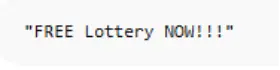
After preprocessing:

Step 3: Feature Extraction
The textual data is converted into numerical vectors using:
Bag of Words (BoW)
TF-IDF
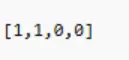
Example vocabulary:

Sentence:
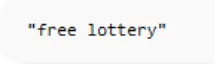
Vector:
Step 4: Train Decision Tree Model
The algorithm selects the best features using:
Entropy
Information Gain
Gini Index
The tree structure is generated automatically.
Example decision rule:
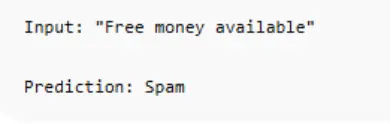
Step 5: Prediction
The trained model predicts the class of new text documents.
Example:
Applications of Decision Trees in NLP
Application | Example |
Spam Detection | Email classification |
Sentiment Analysis | Positive/negative prediction |
News Classification | Topic categorization |
Chatbot Intent Detection | User intent prediction |
Fake News Detection | Authenticity analysis |
Random Forest in NLP
Random Forest is an ensemble learning technique that combines multiple Decision Trees.
Instead of using one tree, Random Forest creates many trees and combines their predictions.
This improves:
Accuracy
Stability
Generalization
Random Forest Prediction Formula

Where:
N= Number of trees
XGBoost in NLP
XGBoost (Extreme Gradient Boosting) is an advanced ensemble algorithm based on boosting techniques.
It sequentially builds trees where each new tree corrects errors made by previous trees.
XGBoost is widely used because of:
High accuracy
Fast performance
Excellent optimization
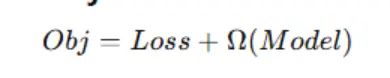
Objective Function in XGBoost
Where:
Loss = Prediction error
Ω = Regularization term
Practical Implementation
Problem Statement
Build a spam classifier using Decision Tree.
```
#Import libraries
import pandas as pd
from sklearn.feature_extraction.text import TfidfVectorizer
from sklearn.model_selection import train_test_split
from sklearn.tree import DecisionTreeClassifier
from sklearn.metrics import accuracy_score
#Dataset
data = {
"text": [
"Win free lottery",
"Project meeting tomorrow",
"Claim your free prize",
"Submit assignment today",
"Congratulations you won money",
"Team discussion at office"
],
"label": [
"spam",
"ham",
"spam",
"ham",
"spam",
"ham"
]
}
#Create DataFrame
df = pd.DataFrame(data)
#Features and target
X = df["text"]
y = df["label"]
#TF-IDF Vectorization
vectorizer = TfidfVectorizer()
X_vectorized = vectorizer.fit_transform(X)
#Split dataset
X_train, X_test, y_train, y_test = train_test_split(
X_vectorized,
y,
test_size=0.3,
random_state=42
)
#Create model
model = DecisionTreeClassifier()
#Train model
model.fit(X_train, y_train)
#Prediction
y_pred = model.predict(X_test)
#Accuracy
print("Accuracy:", accuracy_score(y_test, y_pred))
#Test custom sentence
message = ["Free money prize"]
message_vector = vectorizer.transform(message)
prediction = model.predict(message_vector)
print("Prediction:", prediction[0])
```
Conclusion
Decision Trees, Random Forest, and XGBoost are powerful classical machine learning algorithms widely used in Natural Language Processing tasks. Decision Trees provide interpretable rule-based classification, while Random Forest and XGBoost improve performance using ensemble learning techniques. These algorithms remain highly important for NLP applications involving text classification, sentiment analysis, spam detection, and information extraction.
More Nlp tutorials
- Natural Language Understanding (NLU) , Natural Language Generation (NLG) and phases of NL
- Tokenization in NLP and NLP Project Life Cycle
- Coverting The Text to Vector(one hot encoding and bag of words method)
- Convert text to vector: N-grams and TF-IDF method
- Word Embedding
- What is Natural Language Processing ?
All tutorials · Try the free PySpark compiler · Practice challenges