HMM and CRF for Sequence Labelling in NLP
Nlp tutorial · PySpark.in
HMM and CRF for Sequence Labelling in NLP
Hidden Markov Model (HMM) and Conditional Random Field (CRF) are important classical machine learning algorithms used for sequence labeling tasks in Natural Language Processing (NLP). These algorithms are specifically designed to process sequential data where the prediction of one word depends on neighboring words in the sequence.
Sequence labeling is one of the fundamental tasks in NLP and is widely applied in:
Part-of-Speech (POS) Tagging
Named Entity Recognition (NER)
Chunking
Information Extraction
Speech Recognition
Both HMM and CRF are extensively used before the rise of deep learning models and still remain important for understanding the foundations of NLP.
What is Sequence Labeling?
Sequence labeling is the process of assigning labels or tags to each element in a sequence of words.
For example:
Sentence | Tags |
John lives in Delhi | NNP VBZ IN NNP |
Another example in Named Entity Recognition:
Word | Entity Tag |
John | PERSON |
Delhi | LOCATION |
The objective is to predict labels for an entire sequence rather than for individual words independently.
Hidden Markov Model (HMM)
Hidden Markov Model is a probabilistic graphical model used for modeling sequential data.
HMM assumes that:
The current state depends only on the previous state.
Each observed word depends only on the current hidden state.
HMM is based on probability theory and Markov chains.
Components of HMM
An HMM consists of the following components.
Component | Description |
Hidden States | Actual tags/states not directly visible |
Observations | Words in the sentence |
Transition Probability | Probability of moving from one state to another |
Emission Probability | Probability of observing a word from a state |
Initial Probability | Starting state probability |
Markov Assumption
The Markov assumption states that:
The current state depends only on the previous state. Mathematically: This simplifies sequence prediction problems.

Transition Probability in HMM
Transition probability represents the probability of moving from one state to another.
Example:
Probability that a noun appears after a determiner.
Emission Probability in HMM
Emission probability represents the probability of observing a word given a hidden state.
Example:
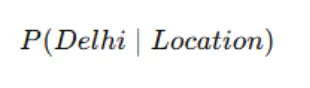
This means:Probability that the word “Delhi” is generated from the tag “Location”.
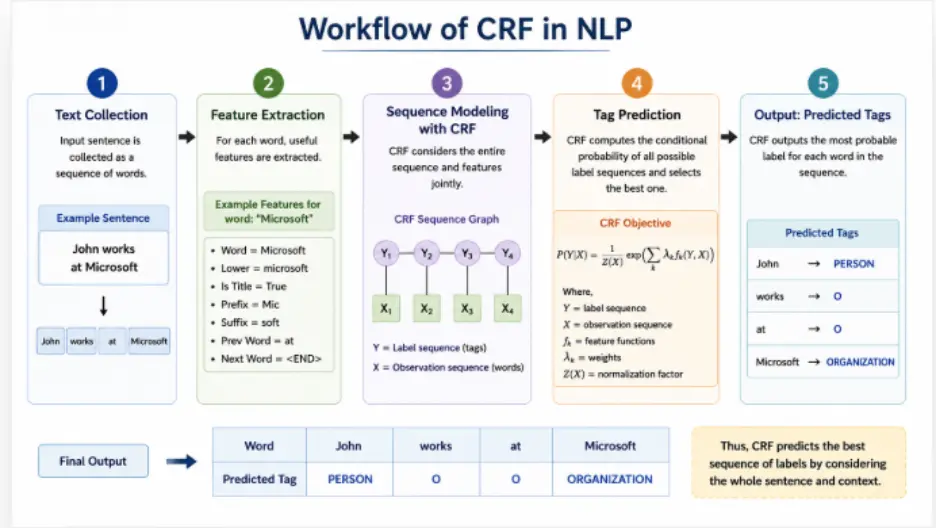
Workflow of CRF in NLP
Step 1: Text Collection
Input sentence:
"John works at Microsoft"
Step 2: Feature Extraction
Extract features such as:
Current word
Previous word
Next word
Capitalization
Prefix/Suffix
Step 3: Sequence Modeling
CRF evaluates the complete sequence jointly.
Step 4: Tag Prediction
Example output:
Word | Tag |
John | PERSON |
Microsoft | ORGANIZATION |
Practical Implementation
```
import sklearn_crfsuite
from sklearn_crfsuite import metrics
# Sample training data
train_data = [
(
[('John', 'NNP'), ('works', 'VBZ'), ('at', 'IN'), ('Google', 'NNP')]
)
]
# Feature extraction function
def word2features(sentence, i):
word = sentence[i][0]
features = {
'word.lower()': word.lower(),
'is_upper': word.isupper(),
'is_title': word.istitle(),
'suffix': word[-3:]
}
return features
# Prepare dataset
X_train = [
[word2features(s, i) for i in range(len(s))]
for s in train_data
]
y_train = [
[label for token, label in s]
for s in train_data
]
# Create CRF model
crf = sklearn_crfsuite.CRF()
# Train model
crf.fit(X_train, y_train)
# Test sentence
test_sentence = [('Microsoft', ''), ('hires', ''), ('engineers', '')]
X_test = [[word2features(test_sentence, i)
for i in range(len(test_sentence))]]
# Prediction
prediction = crf.predict(X_test)
print(prediction)
```
Conclusion
Hidden Markov Model (HMM) and Conditional Random Field (CRF) are foundational sequence labeling algorithms in Natural Language Processing. HMM provides a probabilistic framework for modeling sequential data, while CRF improves prediction quality by considering contextual dependencies and multiple features simultaneously. Although modern deep learning techniques have surpassed them in performance, HMM and CRF remain essential for understanding the evolution and principles of sequence modeling in NLP.
More Nlp tutorials
- Natural Language Understanding (NLU) , Natural Language Generation (NLG) and phases of NL
- Tokenization in NLP and NLP Project Life Cycle
- Coverting The Text to Vector(one hot encoding and bag of words method)
- Convert text to vector: N-grams and TF-IDF method
- Word Embedding
- What is Natural Language Processing ?
All tutorials · Try the free PySpark compiler · Practice challenges