Naive Bayes for Text Classification
Nlp tutorial · PySpark.in
Naive Bayes for Text Classification in Natural Language Processing (NLP)
Naive Bayes is one of the most fundamental and widely used supervised machine learning algorithms in the field of Natural Language Processing (NLP). It is primarily employed for solving classification problems such as spam detection, sentiment analysis, document categorization, and email filtering. The algorithm is based on the principles of probability theory and Bayes’ Theorem. Despite its simplicity, Naive Bayes performs remarkably well for textual data classification tasks
Introduction to Naive Bayes
Naive Bayes is a probabilistic classifier that predicts the category of a given text document by calculating the probability of the document belonging to a particular class. The term “Naive” refers to the assumption that all features are independent of one another. For example, in a sentence such as:
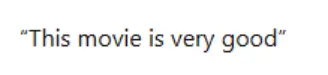
the algorithm assumes that the words “movie”, “very”, and “good” contribute independently toward the classification result. Although this assumption is not entirely realistic, the algorithm still provides highly effective results in many real-world NLP applications.
Bayes’ Theorem
Naive Bayes is derived from Bayes’ Theorem, which describes the probability of an event based on prior knowledge of conditions related to the event. In text classification, the algorithm computes the probability of a document belonging to each class and assigns the document to the class with the highest probability.
The mathematical representation is:
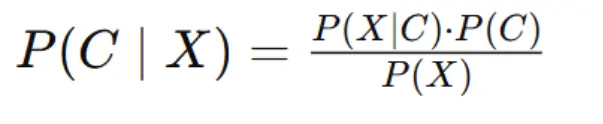
Where:
P(C∣X)P(C|X)P(C∣X) = Posterior Probability
P(X∣C)P(X|C)P(X∣C) = Likelihood Probability
P(C)P(C)P(C) = Prior Probability
P(X)P(X)P(X) = Evidence Probability
Why Naive Bayes is Suitable for NLP
Natural Language Processing tasks involve handling large textual datasets containing thousands of words. Naive Bayes is highly suitable for NLP because:
It performs efficiently on high-dimensional data.
It requires less training data.
It is computationally fast.
It provides good accuracy for text classification tasks.
It works well with sparse datasets
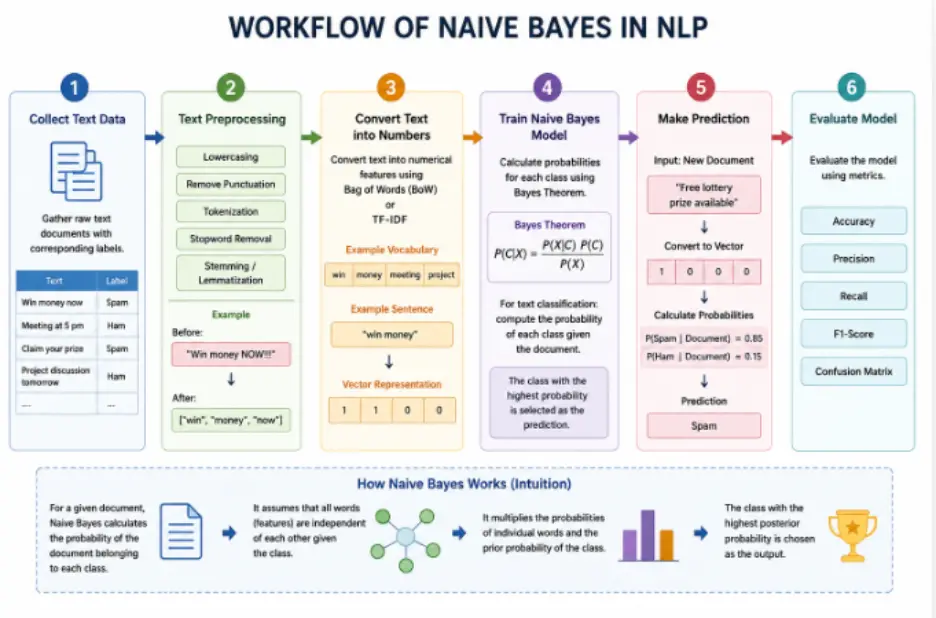
Workflow of Naive Bayes in NLP
The implementation of Naive Bayes in NLP generally follows the following stages.
Step 1: Collection of Text Data
The first step involves gathering textual data for training the model.
Example Dataset
Text | Category |
“Win money now” | Spam |
“Meeting at 5 pm” | Ham |
“Claim your prize” | Spam |
“Project discussion tomorrow” | Ham |
The dataset contains text samples and their corresponding labels
Step 2: Text Preprocessing
Raw textual data contains unnecessary symbols and inconsistencies. Therefore, preprocessing is performed to clean the data.
Common Preprocessing Techniques
Lowercasing
Removal of punctuation
Tokenization
Stop-word removal
Stemming
Lemmatization
Example
Before preprocessing:
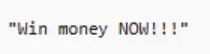
After preprocessing:
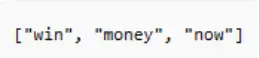
Step 3: Feature Extraction
Machine learning algorithms cannot directly process textual data. Therefore, text is converted into numerical vectors.
Two commonly used techniques are:
Bag of Words (BoW)
TF-IDF (Term Frequency–Inverse Document Frequency)
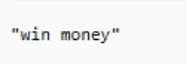
Example Vocabulary

Sentence:
Vector Representation:
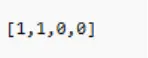
This numerical representation becomes the input for the classifier.
Step 4: Training the Naive Bayes Model
During training, the algorithm calculates the probabilities associated with each class.
For spam detection:
The model predicts the class that has the maximum posterior probability.

Laplace Smoothing
One major problem in Naive Bayes is the occurrence of zero probability. If a word does not appear in the training data for a particular class, its probability becomes zero, which may affect the entire prediction.
To overcome this issue, Laplace Smoothing is applied.
The formula is:

This technique is also known as Add-One Smoothing.
Applications of Naive Bayes in NLP
Naive Bayes has several practical applications in Natural Language Processing.
Application | Example |
Spam Detection | Gmail spam filtering |
Sentiment Analysis | Positive/negative review classification |
News Categorization | Sports, politics, technology |
Language Detection | English, Hindi, French |
Email Classification | Promotions, updates, social |
Practical Implementation Using Python
Problem Statement
Develop a spam email classifier using Multinomial Naive Bayes.
Installation of Required Libraries
```
pip install pandas scikit-learn
```
Example:
```
import pandas as pd
from sklearn.feature_extraction.text import CountVectorizer from sklearn.model_selection import train_test_split from sklearn.naive_bayes import MultinomialNB from sklearn.metrics import accuracy_score, classification_report
Creating dataset
data = {
"text": [
"Win money now",
"Claim your free prize",
"Meeting at 10 am",
"Project discussion tomorrow",
"Congratulations you won lottery",
"Let us complete assignment"
],
"label": [
"spam",
"spam",
"ham",
"ham",
"spam",
"ham"
]
}
Creating DataFrame
df = pd.DataFrame(data)
Input and output variables
X = df["text"]
y = df["label"]
Converting text into vectors
vectorizer = CountVectorizer()
X_vectorized = vectorizer.fit_transform(X)
Splitting dataset
X_train, X_test, y_train, y_test = train_test_split(
X_vectorized,
y,
test_size=0.3,
random_state=42
)
Creating Naive Bayes model
model = MultinomialNB()
Training model
model.fit(X_train, y_train)
Prediction
y_pred = model.predict(X_test)
Accuracy
print("Accuracy:", accuracy_score(y_test, y_pred))
Classification report
print(classification_report(y_test, y_pred))
Testing custom message
message = ["Free lottery prize available"]
message_vector = vectorizer.transform(message)
prediction = model.predict(message_vector)
print("Prediction:", prediction[0])
```
Conclusion
Naive Bayes is one of the most efficient and beginner-friendly algorithms for text classification in Natural Language Processing. Its simplicity, fast computation, and strong performance on textual datasets make it an ideal choice for spam filtering, sentiment analysis, and document categorization tasks. Although the independence assumption is simplistic, the algorithm continues to remain highly effective in practical NLP applications.
More Nlp tutorials
- Natural Language Understanding (NLU) , Natural Language Generation (NLG) and phases of NL
- Tokenization in NLP and NLP Project Life Cycle
- Coverting The Text to Vector(one hot encoding and bag of words method)
- Convert text to vector: N-grams and TF-IDF method
- Word Embedding
- What is Natural Language Processing ?
All tutorials · Try the free PySpark compiler · Practice challenges