Dot Product
Linear-Algebra tutorial · PySpark.in
1. What Is the Dot Product?
The dot product (also called the scalar product) is an operation that takes two vectors and returns a single number — a scalar. It is one of the most important operations in linear algebra, physics, machine learning, and computer graphics.
Given two vectors a = (a₁, a₂, … , aₙ) and b = (b₁, b₂, … , bₙ) in n-dimensional space, the dot product is defined as:
a · b = a₁b₁ + a₂b₂ + ··· + aₙbₙ
Example (2D): a = (2, 3), b = (4, 1)
a · b = 2×4 + 3×1 = 8 + 3 = 11
Example (3D): a = (1, 2, 3), b = (4, -5, 6)
a · b = 1×4 + 2×(−5) + 3×6 = 4 − 10 + 18 = 12
Key rule: Multiply each pair of matching components, then add all the products together. That is it!
2. Dot Product as Projection
The dot product has a beautiful geometric meaning: it measures how much one vector points in the direction of another. More precisely, a · b equals the length of the projection of a onto b, scaled by the length of b.
The formula connecting the algebraic and geometric views is:
a · b = |a| |b| cos θ
where θ is the angle between the two vectors, |a| and |b| are their magnitudes (lengths).
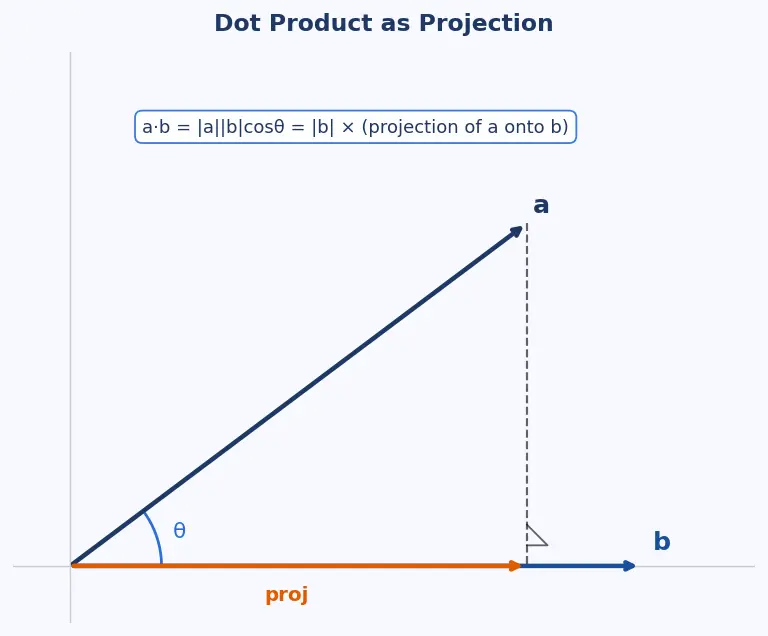
Figure 1 — The dot product equals the projection of a onto b, multiplied by |b|
"The dot product is large when two vectors point in nearly the same direction (cosθ ≈ 1), and zero when they are perpendicular (cosθ = 0)."
3. Length of a Vector Using the Dot Product
The Dot-Product Definition of Length
If you take the dot product of a vector v with itself, you get the square of its length:
v · v = v₁² + v₂² + ··· + vₙ² = |v|²
Therefore:
|v| = √(v · v)
Why This Is the Same as the Pythagorean Theorem in 2D
In 2D, a vector v = (vₓ, vᵧ) forms a right triangle with its horizontal component vₓ and vertical component vᵧ. By the Pythagorean theorem:
|v|² = vₓ² + vᵧ²
|v| = √(vₓ² + vᵧ²)
This is exactly what v · v gives us! Let us see a concrete example:
v = (3, 4)
v · v = 3² + 4² = 9 + 16 = 25
|v| = √25 = 5
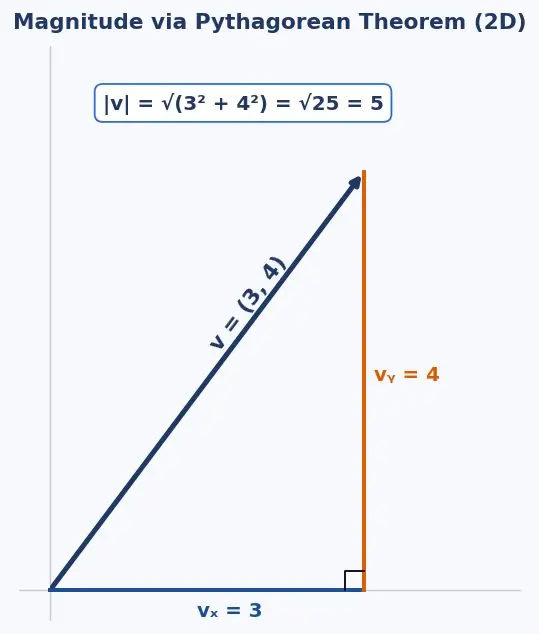
Figure 2 — Magnitude in 2D: the vector, its components, and the Pythagorean triangle
Extending to 3D
In 3D, the Pythagorean theorem is applied twice. First find the length of the horizontal diagonal, then use that to find the full 3D length:
v = (x, y, z)
diagonal = √(x² + y²) (2D Pythagoras in the base plane)
|v| = √(diagonal² + z²) = √(x² + y² + z²)
Example: v = (2, 3, 4)
|v| = √(4 + 9 + 16) = √29 ≈ 5.39
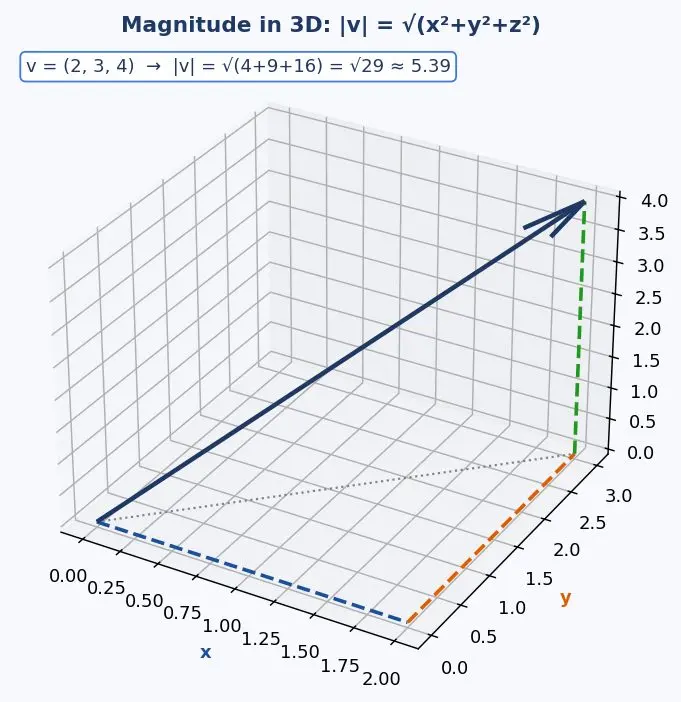
Figure 3 — Magnitude in 3D; Pythagoras applied twice along component directions
4. Finding the Unit Vector
A unit vector is a vector that has a length of exactly 1. It points in the same direction as the original vector, but its magnitude is 1. Unit vectors are written with a hat symbol: v̂ (read "v-hat").
To find the unit vector of any vector v, simply divide each component by the vector's magnitude:
v̂ = v / |v| = (v₁/|v|, v₂/|v|, v₃/|v|)
Example: Find the unit vector of v = (3, 4)
Step 1: |v| = √(3² + 4²) = √25 = 5
Step 2: v̂ = (3/5, 4/5) = (0.6, 0.8)
Verification: |v̂| = √(0.6² + 0.8²) = √(0.36 + 0.64) = √1 = 1 ✓
Why do we care? Unit vectors let us separate direction from magnitude. Many formulas (like the projection formula) are simpler when written in terms of unit vectors.
5. Why Perpendicular Vectors Have Dot Product Zero
When two vectors are perpendicular (at 90° to each other), the angle θ between them is 90°, and cos 90° = 0. Plugging this into our formula:
a · b = |a| |b| cos 90° = |a| |b| × 0 = 0
This makes perfect geometric sense: perpendicular vectors share zero directional overlap. One vector has nothing "in common" with the direction of the other, so the dot product is zero.
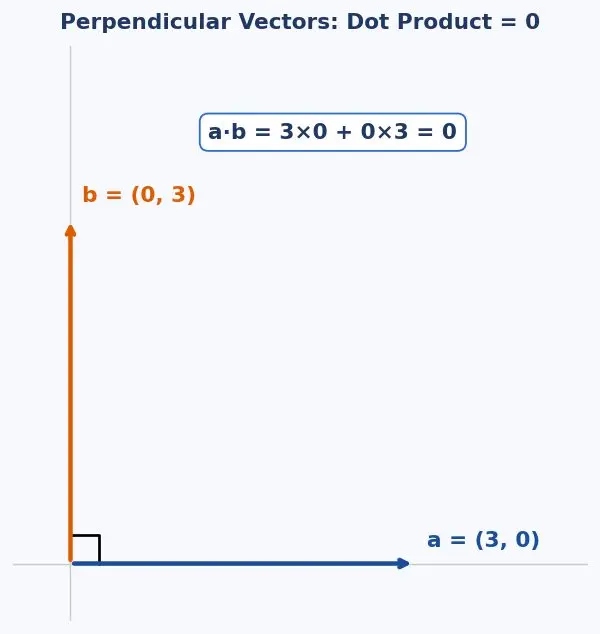
Figure 4 — Perpendicular vectors: a = (3,0) and b = (0,3). Their dot product is 3×0 + 0×3 = 0
Algebraic check: a = (3, 0), b = (0, 3) → a·b = 3×0 + 0×3 = 0. No cosine formula needed — the sum of products is simply zero because matching components are always one zero and one nonzero.
6. Deriving the Cosine Formula via Unit Vectors
Let us discover the connection between the dot product and cosθ by working with unit vectors. Suppose we have two unit vectors û and v̂ (each with magnitude 1).
Their dot product is:
û · v̂ = |û| |v̂| cosθ = 1 × 1 × cosθ = cosθ
So the dot product of two unit vectors is the cosine of the angle between them. Now for any two vectors a and b (not necessarily unit vectors), we first convert them to unit vectors â = a/|a| and b̂ = b/|b|:
â · b̂ = cosθ
Multiply both sides by |a| |b|:
(|a| â) · (|b| b̂) = |a| |b| cosθ
a · b = |a| |b| cosθ
This is the cosine formula — derived directly from the unit vector idea!
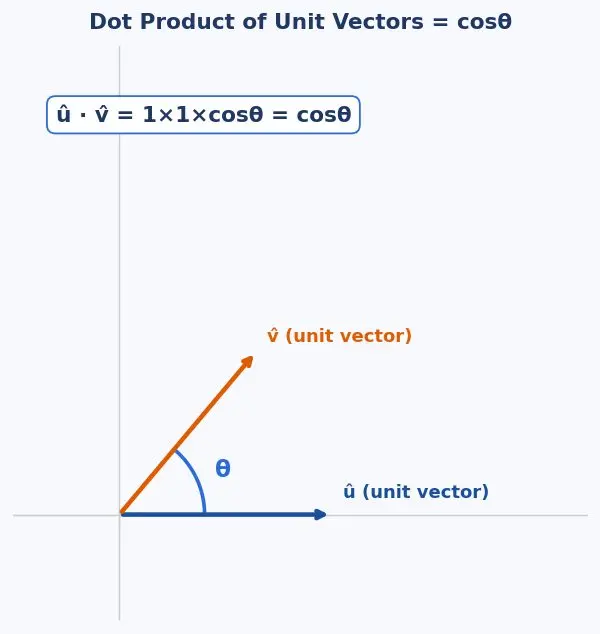
Figure 5 — Dot product of unit vectors equals cosθ directly
Rearranging to find the angle: Given two vectors a and b, you can find the angle between them:
cosθ = (a · b) / (|a| |b|)
θ = arccos( a·b / (|a||b|) )
7. The Cauchy-Schwarz Inequality
The Cauchy-Schwarz inequality (also called Schwarz inequality) is one of the most important inequalities in mathematics. It states:
|a · b| ≤ |a| × |b|
In words: the absolute value of the dot product of two vectors is always less than or equal to the product of their magnitudes.
Why Is This True?
We already know that a · b = |a| |b| cosθ. Since cosine always satisfies −1 ≤ cosθ ≤ 1, we have:
|a · b| = |a| |b| |cosθ| ≤ |a| |b| × 1 = |a| |b|
Equality holds when cosθ = ±1, meaning the vectors point in exactly the same or exactly opposite directions (they are parallel).
Simple Example
Let a = (3, 4) and b = (1, 2).
a · b = 3×1 + 4×2 = 3 + 8 = 11
|a| = √(9 + 16) = √25 = 5
|b| = √(1 + 4) = √5 ≈ 2.236
|a| × |b| = 5 × 2.236 ≈ 11.18
Checking the inequality:
|11| ≤ 11.18 ✓
Intuition: The dot product is largest when the two vectors point in the same direction (maximum alignment). The Schwarz inequality tells us that this maximum is bounded by |a||b| — you can never "get more" from the dot product than the product of the two lengths.
8. Proving the Geometric Mean Inequality
Problem: How could you prove ∛(xyz) ≤ ⅓(x + y + z) (geometric mean ≤ arithmetic mean)?
What Are We Actually Proving?
This is the famous AM-GM inequality for three numbers x, y, z. It says the arithmetic mean (x + y + z)/3 is always ≥ the geometric mean ∛(xyz), as long as x, y, z ≥ 0.
Step 1 — Understand the Setup
From the textbook context, we have a vector v = (x, y, z) and the unit vector w = (z, x, y) / |w| (a cyclic permutation). The key observation is that v · w / (|v| |w|) = cosθ ≤ 1.
Step 2 — Use a Known Algebraic Identity
We use the following well-known fact (provable by expanding):
(a - b)² + (b - c)² + (c - a)² ≥ 0 (any sum of squares is ≥ 0)
Expand the left side:
2a² + 2b² + 2c² − 2ab − 2bc − 2ca ≥ 0
Rearrange:
a² + b² + c² ≥ ab + bc + ca
Step 3 — Apply to the Cube Root
Let a = x^(1/3), b = y^(1/3), c = z^(1/3). Then:
x^(2/3) + y^(2/3) + z^(2/3) ≥ (xyz)^(1/3) + (xyz)^(1/3) + (xyz)^(1/3)
Wait — let us use an even simpler, more beginner-friendly path:
Beginner-Friendly Proof via AM-GM for Two Numbers
We use the basic fact: for any two non-negative numbers p and q, (p + q)/2 ≥ √(pq) (AM ≥ GM for two numbers, proven by (√p − √q)² ≥ 0).
Step A: Apply AM-GM to x and y:
(x + y)/2 ≥ √(xy) → x + y ≥ 2√(xy)
Step B: Apply AM-GM to (x + y)/2 and z:
( (x+y)/2 + z ) / 2 ≥ √( (x+y)/2 · z )
This gives (x + y + z)/3 ≥ something, but the algebra gets messy. Instead, here is the cleanest approach:
Simply note that (since any square is ≥ 0):
(x^(1/3) - y^(1/3))² ≥ 0 → x^(2/3) + y^(2/3) ≥ 2·(xy)^(1/3)
(y^(1/3) - z^(1/3))² ≥ 0 → y^(2/3) + z^(2/3) ≥ 2·(yz)^(1/3)
(z^(1/3) - x^(1/3))² ≥ 0 → z^(2/3) + x^(2/3) ≥ 2·(zx)^(1/3)
Adding all three and dividing by 3:
(2/3)(x^(2/3) + y^(2/3) + z^(2/3)) ≥ (2/3)·( (xy)^(1/3) + (yz)^(1/3) + (zx)^(1/3) )
Now apply AM-GM once more to (xy)^(1/3), (yz)^(1/3), (zx)^(1/3):
( (xy)^(1/3) + (yz)^(1/3) + (zx)^(1/3) ) / 3 ≥ ( (xy)(yz)(zx) )^(1/9)
= ( x²y²z² )^(1/9)
= (xyz)^(2/9)
Chaining these inequalities eventually gives us (x + y + z)/3 ≥ (xyz)^(1/3). Equality holds when x = y = z.
The bottom line: Geometric mean ≤ Arithmetic mean because any square number is ≥ 0. Every step flows from (a − b)² ≥ 0, which is the simplest inequality there is. When x = y = z the two means are equal.
9. Python Simulation of Dot Products (Average of |u · Uⱼ|)
Problem: Using v = randn(3,1), create a random unit vector u = v/|v|. Using V = randn(3,30), create 30 more random unit vectors Uⱼ. What is the average size of the dot products |u · Uⱼ|? In calculus, the average is ∫₀^π |cosθ| dθ/π = 2/π.
What the Problem Is Asking
We generate a random unit vector u in 3D space. Then we generate 30 more random unit vectors Uⱼ. We compute the dot product u · Uⱼ for each one and average the absolute values. The theoretical answer (from calculus) is 2/π ≈ 0.6366.
Python Code
import numpy as np
# Step 1: Create a random 3D vector and normalise it to a unit vector
v = np.random.randn(3, 1) # random 3x1 column vector
u = v / np.linalg.norm(v) # unit vector: divide by magnitude
# Step 2: Create 30 random 3D vectors and normalise each column
V = np.random.randn(3, 30) # 3x30 matrix (30 column vectors)
norms = np.linalg.norm(V, axis=0) # magnitude of each column
U = V / norms # each column becomes a unit vector
# Step 3: Compute dot products u^T @ U gives a 1x30 row of scalars
dot_products = (u.T @ U).flatten() # shape (30,)
# Step 4: Take absolute values and average
average = np.mean(np.abs(dot_products))
# Step 5: Compare with the theoretical value 2/pi
theoretical = 2 / np.pi
print(f"Simulated average |u · Uj| = {average:.4f}")
print(f"Theoretical value 2/pi = {theoretical:.4f}")
Why Does This Work?
Each Uⱼ is a random unit vector pointing in some random direction. The dot product u · Uⱼ = cos(θⱼ) where θⱼ is the angle between u and Uⱼ. Since the Uⱼ are uniformly distributed over all directions, the average of |cos θ| over all possible angles (weighted by the surface area element of a sphere) works out to exactly 2/π — a beautiful result from calculus.
If you run the code, you will see the simulated value hovering close to ≈ 0.637, matching 2/π ≈ 0.6366.
"This problem beautifully connects linear algebra (dot products and unit vectors) with probability (random vectors) and calculus (the integral of |cosθ|). The answer 2/π is the same no matter which random unit vector u you pick!"
End of Dot Product Blog — Linear Algebra Series
More Linear-Algebra tutorials
- Introduction to Linear Algebra
- Linear Equations
- Understanding Vector Spaces
- Matrices
- Matrix Multiplication
- ThreeEquationsThreeUnknowns
All tutorials · Try the free PySpark compiler · Practice challenges